

Your knife slips on tomatoes and onions because of this 30-second step almost every cook skips
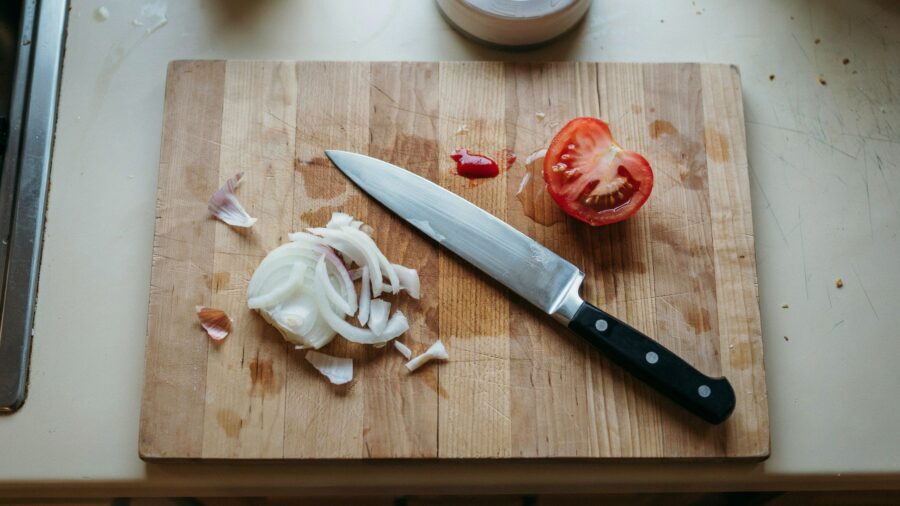
You go to slice a tomato. The knife lands on the skin, presses in, and right when you’re leaning your weight into it, the blade skids sideways. Same thing happens with onions. Slick skin, hard push, and suddenly the knife’s going somewhere you didn’t tell it to go, right toward the hand holding the food.
Most people think this is a sharpness problem. So they either buy a new knife every couple of years, or send the old one out to be sharpened once in a while and hope for the best. Neither one fixes what’s actually going wrong in your kitchen.
The real fix takes less than 30 seconds, costs nothing, and uses a tool that’s been sitting in your knife block since the day you bought it. Almost nobody touches it.
Dull knives send hundreds of thousands of people to the ER every year
This isn’t a scary claim someone made up. The Consumer Product Safety Commission (the federal agency that tracks how people get hurt by everyday products) runs a system called NEISS that pulls injury data from hospitals across the country. A peer-reviewed study in the Journal of Emergency Medicine used that data to count knife injuries, and the number came out to roughly 434,000 ER visits a year in the US, about 1,190 a day. Most of those cuts go to the fingers and thumb.
And it’s not the sharp knives doing the damage. OSHA, the federal workplace safety agency, says it right on their own guidance page: dull knives tend to slip and cause injuries. They list it as one of the most common mistakes anywhere food gets prepped. Mayo Clinic hand surgeon Dr. Sanj Kakar has treated patients who pushed a knife straight through their own hand when the blade slipped off something they were cutting.
The reason is simple. A sharp edge grabs the tomato skin the second it touches down. A dull edge slides across the skin, so you push harder. When the blade finally breaks through, all that pressure you were pushing with releases at once, and there’s nothing left to stop it before it reaches your other hand.
The blade isn’t actually dull. It’s bent.
This is the part almost nobody knows, and it changes what you’re supposed to do about it.
When a knife feels dull, most people picture an edge that’s worn down and rounded off. That’s not usually what’s happening. America’s Test Kitchen explains it this way: every time you push a blade through food, tiny pieces of the edge get bent to one side or the other. The edge is still there. It’s just leaning over, which is why the knife stops cutting cleanly and starts sliding around on slippery stuff.
Consumer Reports describes the same thing in their own knife guide. The metal along the very edge of your blade gets folded during normal use, and light friction against the right kind of rod straightens it back out.
Think of a comb that got squished in a drawer. The teeth aren’t gone. They’re bent. Straighten them and the comb works again.
That’s the reason your knife feels like it went from cutting fine to sliding off tomatoes in what seems like a few weeks. It didn’t wear down. It just leaned over.
The fix is a tool you already own and probably think is just decorative
Go look at your knife block right now. Not the knives. Look at the other slot, the skinnier one.
There’s a long metal rod in there with a handle on one end. It came with the set. If your kitchen is like most kitchens, that rod hasn’t been touched in years. Maybe you’ve picked it up once, waved it around, thought “I don’t know what to do with this,” and put it back. Maybe you thought it was just for looks, or that it’s basically a sharpener, or that only professional chefs use it.
None of that is right. That rod is arguably the most important piece of equipment in your whole knife block, and almost nobody uses it.
It gets ignored because of a naming problem. Most knife sets label it a “sharpening steel” on the box. That’s not what it does. It doesn’t sharpen anything. And when people try to use it as a sharpener and don’t see a huge difference right away, they figure it doesn’t work and give up.
It’s actually called a honing steel. Its job is to take the bent, folded-over edge on your knife and push it back into a straight line. It doesn’t grind metal off. It doesn’t make a fresh edge. It just un-bends the one that’s already there. America’s Test Kitchen has called that “sharpening steel” label a bit of a misnomer for exactly this reason: the steel corrects and trues the edge, it doesn’t really sharpen it.
Sharpening is a totally separate job. That’s the one you do once or twice a year, either by sending your knives out or using a sharpening system at home. That one grinds metal off to make a new edge.
Honing is what you should be doing all the time. It takes seconds. And you already own the tool.
The 30-second step, how to actually do it
Here’s the technique, straight from the tested method at America’s Test Kitchen, with the angle detail from Consumer Reports and the big knife makers.
Set it up. Fold a dish towel on your cutting board and stand the honing rod straight up, tip planted on the towel, handle in your other hand. The towel keeps the rod from slipping around.
Set your angle. If you own a standard Western chef’s knife (Wüsthof, Henckels, Victorinox, or the ones that came with most knife block sets), tilt the blade about 20 degrees off the rod. If it’s a Japanese knife (Shun, Global, most santoku knives), it’s 15 degrees. A cheat that works: slide a matchbook under the spine of the blade and you’re right around the correct angle.
Sweep from heel to tip. Put the back end of the blade (the end closest to the handle) at the top of the rod. Pull the knife down and toward you in one smooth motion, so by the time you reach the bottom of the rod, the tip of the blade is what’s touching. Light pressure only. The weight of the knife is almost enough on its own.
Switch sides. Do the same thing on the other side of the rod. Alternate sides for 4 to 5 passes per side, so about 8 to 10 total swipes. Done.
Repeat before or after every real cooking session. Not once a month. Not once a year. Every time you’re about to break down a bag of vegetables, or right after you finish. That’s what keeps the edge from folding over in the first place.
If you hone regularly and the knife still won’t cut cleanly, that’s when it’s actually time to sharpen. But most home cooks are trying to sharpen when they should be honing.
What changes when you actually do it
Your knife bites into tomato skin on the first touch instead of skating across it. Onion layers fall apart cleanly instead of getting crushed. You stop leaning your body weight into every cut. Your other hand stops sitting in the path of a slip.
The tool has been in the block the whole time. The fix takes less than 30 seconds. It’s a step almost no home cook was ever told to take.
Sources: (1) OSHA, Hospital eTool, Food Services Kitchen Equipment; (2) Journal of Emergency Medicine, Knife-Related Injuries Treated in United States Emergency Departments, 1990–2008; (3) America’s Test Kitchen, How to Use a Honing Rod; (4) America’s Test Kitchen, Knife Tune-Up: How to Use a Honing Rod; (5) Consumer Reports, How to Use the Honing Steel That Comes With Your Knife Set; (6) Mayo Clinic, Dr. Sanj Kakar (hand surgeon reference).
The post Your knife slips on tomatoes and onions because of this 30-second step almost every cook skips appeared first on Trendir.