

This everyday laundry step makes bath towels smell sour by the next morning: a $3 reset fixes it
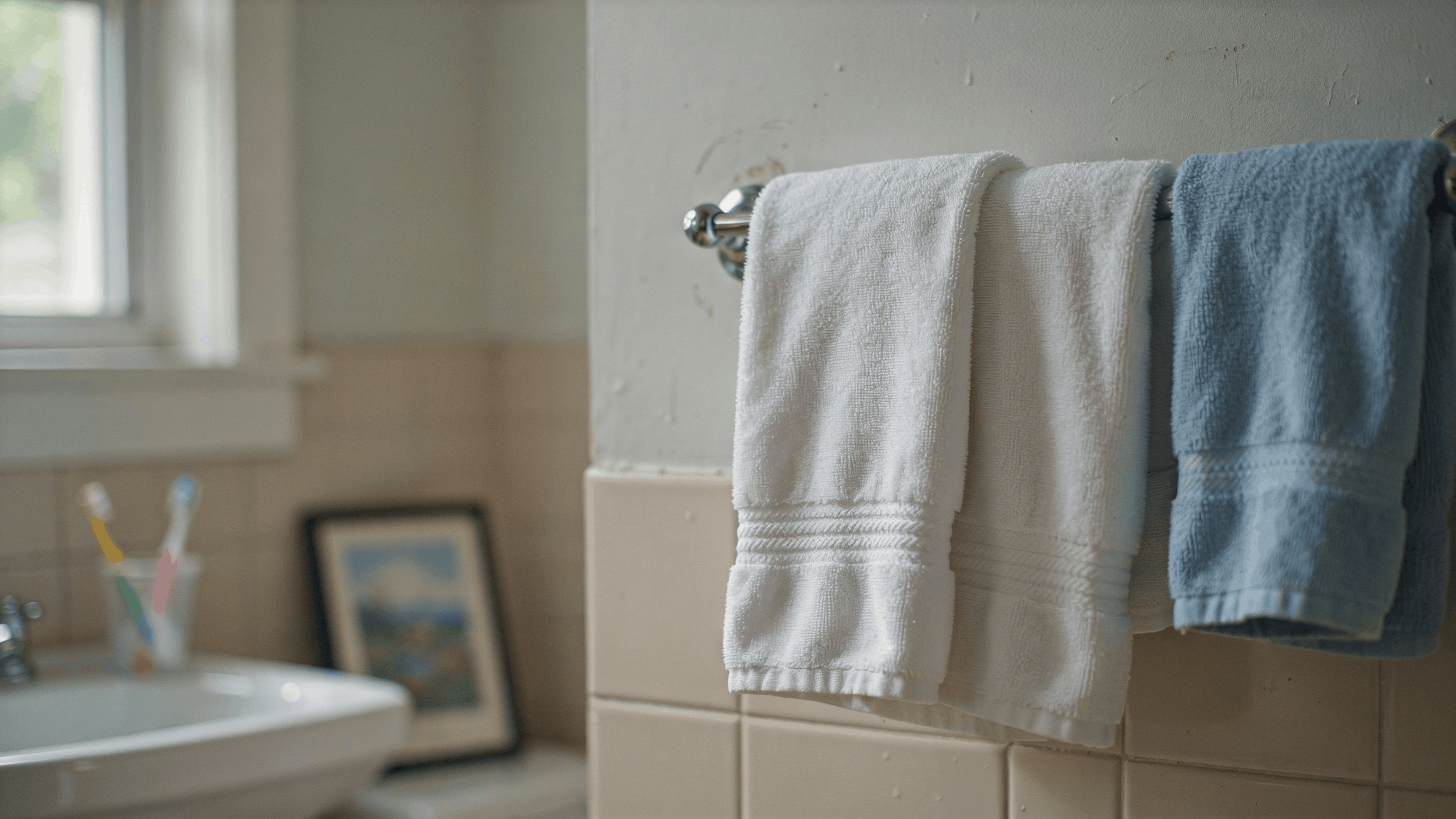
You washed the towels yesterday. You folded them warm out of the dryer. And by the time you dry off after tonight’s shower, that faint sour, wet-rag smell is back.
It’s not you, and it’s not the detergent. Washing them more often will not stop it either. The reason it keeps coming back has a specific name, and the reset that ends it costs less than a cup of coffee.
Before you buy a stronger detergent, a laundry sanitizer, or a whole new set of towels, it helps to know what is actually happening inside the fibers between wash days. Once you see the mechanism, the reason ordinary advice only half-works becomes obvious.
The usual suspects everyone blames first
Most people start by adding more detergent or a stronger one. It does not work, and the science says it never will.
According to the American Cleaning Institute, bath towels only need to be washed after three to five uses, as long as they dry fully in between, guidance repeated across major textile care resources including the Peacock Alley towel care guide. So this is not a hygiene problem. Washing more often just gets you back to the same sour towel a few days later.
The second thing people try is hot water. Closer, but still not the whole answer. Charles Gerba, a microbiologist at the University of Arizona who has spent decades studying household bacteria, has said cold-water washes leave bath towels especially dirty because the terry is so thick. Hot water helps. On its own, it does not stop the smell from coming back.
The reason nothing sticks is that ordinary advice is treating the wrong problem. The sour smell in your bath towel is not leftover soap and it is not a detergent failure. It is a living thing, and it has a name.
The bug behind the smell
In 2012, a team of Japanese researchers led by Hiromi Kubota at Kao Corporation published a study in Applied and Environmental Microbiology, a journal of the American Society for Microbiology, that finally identified what was making laundry smell like a wet dishrag. They tested household towels and clothing, isolated the main organism responsible, and named it: Moraxella osloensis.
Moraxella osloensis lives on human skin. Every time you dry off, some of it transfers to your towel. Once there, it feeds on the traces of sweat, body oil, and skin cells left behind in the fibers and releases a specific compound called 4-methyl-3-hexenoic acid, or 4M3H for short. That acid is the sour, wet-rag smell you keep picking up.
Two findings from that study are worth pausing on, because they explain why the smell is so stubborn. First, Moraxella osloensis only produces the smell on used towels, never on brand new ones, because it needs the leftover skin oil and sweat in the fibers to feed on. Second, it is remarkably tough. The Kubota study documented that it survives being dried out, it survives sunlight, and it survives normal warm-water wash cycles. A follow-up 2024 study in the journal MicrobiologyOpen confirmed it also resists common antimicrobial laundry additives. It only reliably dies at around 140°F, hotter than most American households wash.
Dr. Gerba’s separate research on bathroom towels backs up how loaded the average towel already is. In one study he conducted, coliform bacteria (the group associated with fecal contamination) showed up on nearly 90 percent of bathroom towels tested, and E. coli on about 14 percent, according to reporting from TIME magazine. So the fibers of your “clean” towel are, biologically speaking, already a busy neighborhood the moment they come out of the dryer.
Why detergent alone cannot reach it
Here is where the surprise sits. In every wash, Moraxella osloensis in your towels is being sheltered by a thin, invisible coating you have been adding on purpose, believing it does the opposite.
That coating is fabric softener. Fabric softener works by depositing a thin waxy layer of chemicals (usually quaternary ammonium compounds) onto the fibers. On clothes it feels smooth. On terry cloth towels, that same coating creates a water-repellent shell that traps body oils and moisture in tiny pockets between the loops, giving the bacteria a sheltered, food-rich surface to colonize. Standard detergents are alkaline, and Moraxella thrives in alkaline conditions, so each softener-added wash actually rebuilds the shelter instead of destroying it.
Martha Stewart, in The Martha Manual, has long recommended avoiding fabric softener on towels for exactly this reason, saying she insists on avoiding added scents and fabric softeners to keep her white towels clean. Ashley Matuska Kidder, a laundry expert and founder of the cleaning company Dashing Maids, told The Spruce that leaving damp towels bunched on hooks is one of the biggest smell mistakes people make because mildew, in her words, “loves dark, moist environments.”
So the sequence in most American laundry rooms looks like this. You wash. Detergent lifts surface dirt. Softener leaves its wax film. The towel goes on a hook, folded on itself, and takes six to eight hours to actually dry inside the loops. Once dampness passes about the four-hour mark, whatever Moraxella osloensis survived the wash starts doubling in the sheltered residue. By morning, it is producing 4M3H acid again. That is your sour smell.
Which means the fix has to do two things at once: dissolve the waxy coating, and flip the pH so the bacteria cannot hide anymore.
The $3 reset that actually breaks the cycle
The reset is one wash day. You need two things you probably already have in the kitchen: distilled white vinegar and plain baking soda. A gallon of store-brand white vinegar runs about $3 in most American grocery stores. A box of baking soda is another dollar or so. You will use less than half of each.
The critical rule up front: do not mix them in the same cycle. Vinegar is acidic, baking soda is alkaline, and together they neutralize each other into salty water and do nothing. This is called out explicitly in The Spruce’s dish-towel refresh guide, and it applies here too. Run them back to back, in this exact order.
Do this:
Cycle 1, hot water with vinegar only. Load only the towels, nothing else. Skip detergent entirely. Pour 1 cup of distilled white vinegar into the drum, or into the fabric softener compartment on a front loader. Run the longest wash cycle at the hottest setting, which should read close to 140°F. The acetic acid dissolves the softener wax and mineral buildup, and drops the pH low enough to kill Moraxella osloensis. Textile care guides including Peacock Alley confirm this same first step.
Cycle 2, hot water with baking soda only. Leave the towels in the drum. Add 1/2 cup of plain baking soda directly to the drum. Skip detergent again. Run a second hot cycle. The baking soda lifts anything the vinegar loosened and pulls remaining odor molecules out of the fibers.
Dry fully, ideally in a hot dryer. Do not stop the dryer early. Do not fold or store any towel that still feels cool or heavy in the center. Damp storage after all this restarts the whole cycle.
Two things you will notice right away. The towels come out feeling noticeably rougher, because that is what real cotton feels like once the wax coat is gone. And they smell like nothing at all, not like detergent perfume, not like anything. Neutral is the correct outcome.
Keeping the smell from coming back
The reset only holds if you stop feeding the coating. Going forward:
Skip fabric softener on towel loads, permanently. If you want a softer feel, add 1/2 cup of distilled white vinegar to the rinse dispenser. It softens without leaving a wax coat.
Wash towels alone, in warm or hot water, with about two-thirds of the detergent the cap recommends. Too much detergent leaves residue that starts the buildup over.
Hang towels spread flat, not folded on a hook. A bar with the towel opened fully across it dries in a few hours; a folded hook takes overnight. Kidder specifically warned about this in her Spruce interview.
Run the bathroom exhaust fan during and after every shower, and leave the door open when you can. Bacteria need moisture. Cut the moisture, cut the smell.
Only store fully dry towels. If any part still feels cool to the touch, it is still damp inside the loops. Wait.
Do the reset once. Follow the five habits above. The sour-by-morning cycle stops.
Sources: (1) Kubota et al., “Moraxella species are primarily responsible for generating malodor in laundry,” Applied and Environmental Microbiology, 2012; (2) TIME magazine reporting on Charles Gerba’s bath towel bacteria research; (3) Peacock Alley Towel Care Guide, citing American Cleaning Institute guidance; (4) The Spruce, “We Asked Laundry Pros Why Our Towels Smell Like Mildew,” featuring Ashley Matuska Kidder; (5) Martha Stewart Living, “Fabric Softener Ruins Towels Faster Than You Think“; (6) Watanabe et al., MicrobiologyOpen, 2024, on Moraxella osloensis resistance
The post This everyday laundry step makes bath towels smell sour by the next morning: a $3 reset fixes it appeared first on Trendir.