

One item in almost every kitchen is quietly putting bacteria in your food: you use it every day
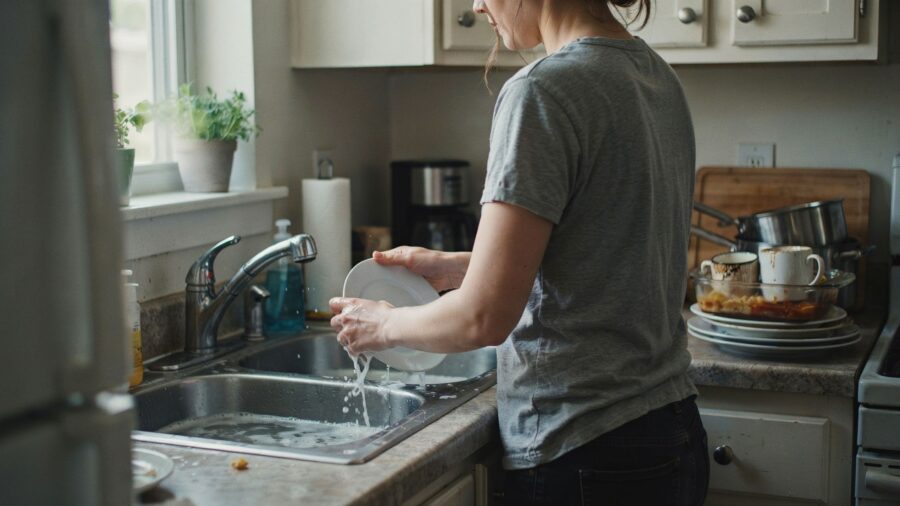
You wash your hands. You keep raw meat away from your veggies. You even clean your sponge every few days because you saw a TikTok about it. By any normal standard, your kitchen is clean.
And yet food safety researchers keep pointing at the same quiet spot on your counter and saying, that’s where the real problem is.
It isn’t your sponge. It isn’t your sink drain. It isn’t the door of your fridge. It’s something you’ve probably owned for years, use almost every day, and have never once thought about replacing. Most people assume it’s the safest, most hygienic option they’ve got. That assumption is exactly what makes it risky.
The move you think is safe is the one causing the problem
Nearly every American kitchen runs the same routine with this item. You bought it because it was cheap, light, easy to rinse, and looked clean. You use it for raw chicken, raw beef, raw fish, whatever needs a knife. When it starts looking a little scratched up, you shrug and keep going, because it feels fine. You toss it in the dishwasher when you remember and figure hot water and soap will take care of anything you can’t see.
Sounds responsible. It’s actually the exact behavior that turns a normal kitchen tool into a bacteria hideout.
The problem is the surface. Every time your knife hits it, you leave a tiny groove. Those grooves add up. After a couple of years of daily use, the “clean-looking” top isn’t smooth anymore. It’s covered in microscopic canyons, and each one is deep enough to hide bacteria from soap, from hot water, and, in some cases, even from your dishwasher.
Which is where the story stops being “eh, probably fine” and starts being a real health story with real numbers behind it.
What the research actually says
The most-cited work on this comes from Dr. Dean Cliver, a food safety scientist who ran a long string of studies, first at the University of Wisconsin-Madison and later at UC Davis. His team put nasty bacteria (Salmonella, E. coli, and Listeria) onto brand new and worn-out cutting boards, some plastic, some wood, and watched what happened next.
The finding that shook up the food safety world: on the plastic boards, the bacteria stuck around on the surface, survived washing, and could be found later. On the wooden boards, at least 98% of the bacteria (and often over 99.9%) just vanished from the surface within minutes. Cliver’s team couldn’t find them again, no matter how hard they scrubbed.
The line that really lands is from Cliver’s own summary of his research: plastic boards with knife scratches were “impossible to clean and disinfect manually,” especially when there was leftover food gunk like chicken fat sitting in the grooves. Michigan State University Extension puts it even more plainly, saying those tiny hiding spots in the grooves “can protect bacteria even on plastic cutting boards that go through the dishwasher.”
Your dishwasher isn’t saving you. That’s the part almost nobody knows.
There’s also real-world data, not just lab data. Back in 1992, a study in the journal Annals of Epidemiology looked at Salmonella cases across four counties in northern California to figure out what put people at risk. Households using plastic or glass cutting boards were about twice as likely to catch Salmonella as the average household. Households using wooden boards were less than half as likely. And here’s the kicker: how often people cleaned their board didn’t really change the outcome. The material mattered more than the washing.
So what is it, and what should you do about it?
The item is your plastic cutting board, especially the older one with the deep knife grooves and the faint stains that never fully wash out. If it’s the board you grab when you’re breaking down raw chicken or trimming a steak, that’s the highest-risk version of the problem.
The fix costs less than a decent takeout meal and doesn’t add a single step to how you already cook.
Do this:
Toss any plastic cutting board with visible, deep knife grooves, especially if you use it for raw meat. USDA’s Food Safety and Inspection Service says the same thing in plain terms: once a board has “hard-to-clean grooves,” throw it out. Run your fingernail across the surface. If it catches on the grooves, it’s done.
Get one solid hardwood board for raw meat. The research-backed options are maple, walnut, cherry, and teak, all dense, tight-grained woods that don’t scratch up easily. A good entry-level one runs about $15 to $40 (roughly €14 to €37) at any big-box or kitchen store. The FDA’s Food Code specifically allows maple and similar close-grained hardwoods for food prep, so this isn’t fringe advice, it’s just the option most people don’t reach for.
Wash it by hand with hot soapy water after every use, then stand it on its edge to air dry. Don’t put a wooden board in the dishwasher. The heat and long soak will warp it. A 30-second hand wash is all it needs.
Keep a second board just for produce. USDA recommends one board for raw meat and a separate one for anything that isn’t getting cooked, so bacteria from the meat side can’t hitch a ride onto your salad.
That’s it. One swap. Under $40 (about €37). No new routine, no new gadget, nothing to learn.
One more reason it’s worth doing
There’s a second problem stacked on top of the bacteria one, and it also traces back to the same board. A 2023 study in the journal Environmental Science & Technology found that a single year of typical use on a plastic cutting board can shed somewhere between 1,536 and 7,680 microplastic bits into the food you’re cutting. A separate 2022 study tracked those same bits right off polyethylene (a common plastic used in cutting boards) and into cut chicken and fish.
So the board isn’t just holding onto bacteria your dishwasher can’t reach. It’s also flaking tiny pieces of plastic straight into dinner. Both problems solved by the same $30 (about €28) swap.
Sources: (1) USDA Food Safety and Inspection Service, Cutting Boards; (2) Dr. Dean Cliver, University of Wisconsin-Madison / UC Davis, Plastic and Wooden Cutting Boards; (3) Ak, Cliver & Kaspar, “Cutting Boards of Plastic and Wood Contaminated Experimentally with Bacteria,” Journal of Food Protection 57:16-22, 1994; (4) Michigan State University Extension, Safely Using and Caring for Cutting Boards; (5) Kass et al., “Disease determinants of sporadic salmonellosis in four northern California counties,” Annals of Epidemiology 2:683-696, 1992; (6) Yadav et al., “Cutting Boards: An Overlooked Source of Microplastics in Human Food?,” Environmental Science & Technology 57:8225-8235, 2023; (7) Habib et al., “Microplastic Contamination of Chicken Meat and Fish through Plastic Cutting Boards,” 2022.
The post One item in almost every kitchen is quietly putting bacteria in your food: you use it every day appeared first on Trendir.