

She has the same mirror and lights as everyone else: one detail is why her makeup never looks off in daylight
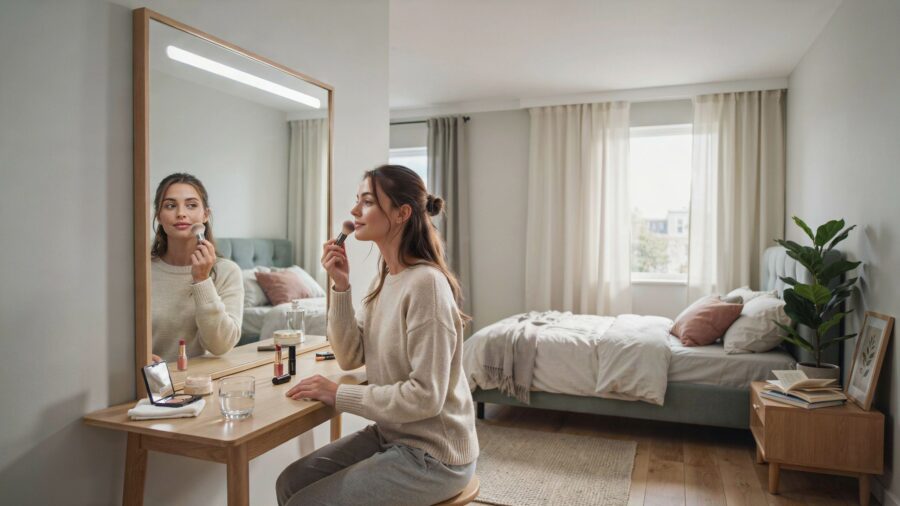
You did everything the vanity guides told you to do. You’ve got a mirror. You’ve got lights on both sides. Your bathroom is brighter than the one you grew up with. And still, most mornings, you finish your makeup, feel great about it, walk outside, catch yourself in a car window, and there it is again. Foundation that suddenly looks orange. Blush that reads way too pink. Concealer sitting like a stripe under your eye.
You know the woman this never happens to. Her mirror looks like yours. Her lights look like yours. Her whole setup is, honestly, kind of plain. But her face at brunch matches her face in the car matches her face at work. Same face all day. She isn’t better at makeup than you. She didn’t spend more on her bathroom. She just knows something about her setup that almost nobody mentions on the way through the store.
What the guides get almost right
The regular advice isn’t wrong. It just stops one sentence short.
Every good vanity article will tell you the same three things. Put light on both sides of your mirror, not just above it. Mount those lights around eye level. Space them wide enough to cover your whole face. That advice traces back to the American Lighting Association, which places side lights about 65 to 70 inches (165 to 178 cm) off the floor, roughly at eye level. Designers repeat it for a good reason. Light from both sides fills in the shadows under your eyes, nose, and chin instead of digging them deeper the way one light bar overhead does.
So you did that part. Two lights, sides of the mirror, right height. That should be the end of the story.
Except your makeup still doesn’t match daylight. Which means the story isn’t done. Where the light comes from is only half of it. The other half is what the light itself is actually made of. And that half almost never makes it into the article.
The part the guides skip
The most important fact about your vanity isn’t the mirror, the fixtures, or the wattage. It’s printed on a small label on the side of the bulb box, in a font you’ve probably never bothered to read. And most bathrooms in America (and most bathrooms everywhere else) are running the wrong version of it.
Bulbs come in different flavors of white. Warm white, the kind of glow you get from a candle or a table lamp at sunset, feels cozy in a bathroom. It softens your skin in the mirror. It’s also the kind of white most bulbs come in by default, because that’s what sells. The lighting brand GoodBulb spells out the trap plainly in its own vanity guide: warm bulbs make your face look flattering under the mirror, but they’re the exact reason your makeup looks different the moment you step outside. The bulb was lying to you. Nicely, but still.
Real outdoor daylight (the light you actually live your day in) is a very different color of white. Cooler. Cleaner. Closer to noon sun. The upscale lighting shop Edward Martin puts it flat out in its bathroom lighting guide: even perfectly bright light will throw off your makeup if it’s the wrong color, and getting the color right is what separates guessing at your foundation shade from actually seeing it. The makeup wasn’t changing when you stepped outside. You were never really seeing it at the mirror.
That’s not the whole answer, though.
Because two bulbs can be the same color of white and still show your skin two different ways. There’s a second thing on the bulb box that decides how honestly a bulb shows the real color of anything under it (your skin, your foundation, your lipstick). Most cheap bathroom bulbs are only okay at this. The lighting company Wave Sold says right on its vanity guide that regular household bulbs are acceptable for lighting a room, and openly not good enough for makeup. Permanent makeup artists (the people who tattoo eyebrows and lips onto clients for a living) go even further. CosmoGlo’s professional lighting guide sets a much higher bar for their studios, because anything less shifts how skin tones and pigments actually appear.
So it’s not one number on the box. It’s two. And the woman whose makeup always looks right just quietly bought the right ones.
The fix, in the exact words on the box
You don’t need to remember any of the technical terms. You just need to know what to look for on the label so you can walk into any hardware store (or type it into any search bar) and get the same result a professional would.
Do this:
Buy bulbs that say “Daylight” and 5000K on the packaging. Not “Soft White” (that’s the warm yellow one, 2700K). Not “Bright White” (still too warm, usually 3500 to 4100K). You want the one that says Daylight with the number 5000K printed on the box. 5000K matches noon sun. That’s the whole point.
Look for a CRI number of 90 or higher on the box, usually printed as “CRI 90+” or “90+ CRI.” This is the honesty score. If the box doesn’t list a CRI number at all, that almost always means it’s below 90, and you should skip it. The good ones brag about it in big letters because it’s the reason they cost a couple of dollars more.
Put one on each side of the mirror, not overhead. If all you’ve got is a light bar above the mirror, swapping the bulbs alone will still help a lot. But the biggest jump comes from two lights on the sides, roughly at face height (about 60 to 65 inches, or 152 to 165 cm, from the floor), spaced roughly a shoulder-width or two apart.
Don’t want to touch any wiring? Buy a plug-in lighted vanity mirror with adjustable color temperature, and set it to daylight. The good ones cover 5000K and run roughly $80 to $300 (about €75 to €280).
That’s it. Two bulbs, or one plug-in mirror. The whole professional setup, minus the studio.
Sources: (1) Houzz on American Lighting Association vanity placement guidance; (2) Capitol Lighting bathroom vanity sconce placement guide; (3) GoodBulb, best Kelvin temperature for bathrooms; (4) Edward Martin, how bright should a bathroom vanity light be for applying makeup; (5) Wave Sold, choosing vanity light bulbs; (6) CosmoGlo, permanent makeup artist lighting guide.
The post She has the same mirror and lights as everyone else: one detail is why her makeup never looks off in daylight appeared first on Trendir.