

You brush twice a day, floss, use mouthwash, and one toothbrush habit almost every home has is undoing all of it
You do everything right. Two minutes twice a day, floss most nights, mouthwash you actually kind of like the burn of. Your dentist tells you your gums look great and you leave the office feeling pretty good about yourself.
Then you go home and put your toothbrush right back in the exact spot that’s been quietly working against you the whole time.
Almost every bathroom in America does this. It’s so normal that nobody thinks about it, and that’s the whole problem. The habit doesn’t look dirty. Your brush seems clean. It smells fine. It even feels clean when you grab it the next morning. But what happens to it between uses is doing something the quick rinse under the tap can’t fix, and the routine you’re proud of can’t outrun.
The fix costs almost nothing and takes about two seconds. The reason so few people do it is that nobody ever told them the “normal” way was the wrong way.
What science actually says about your toothbrush
The stuff living on the thing you put in your mouth twice a day is not what you’d hope.
Researchers at Quinnipiac University in Connecticut studied shared bathrooms and presented their findings at a big meeting of microbiologists (the American Society for Microbiology). What they found was ugly: 60% of the toothbrushes tested positive for fecal bacteria. Yes, the kind that comes from poop. And there was an 80% chance those germs came from someone else in the same bathroom, not the brush’s owner.
The lead researcher, Lauren Aber, said the real worry isn’t your own germs on your brush, but somebody else’s, since those aren’t the ones your body is used to fighting off.
That study was in college dorm bathrooms. Yours probably isn’t shared with nine other people. But the reason it happened has nothing to do with dorms. It’s about the air in the room, water splashing around, and what your brush is touching between uses. All of that is happening in your home bathroom too.
The one habit almost every home shares
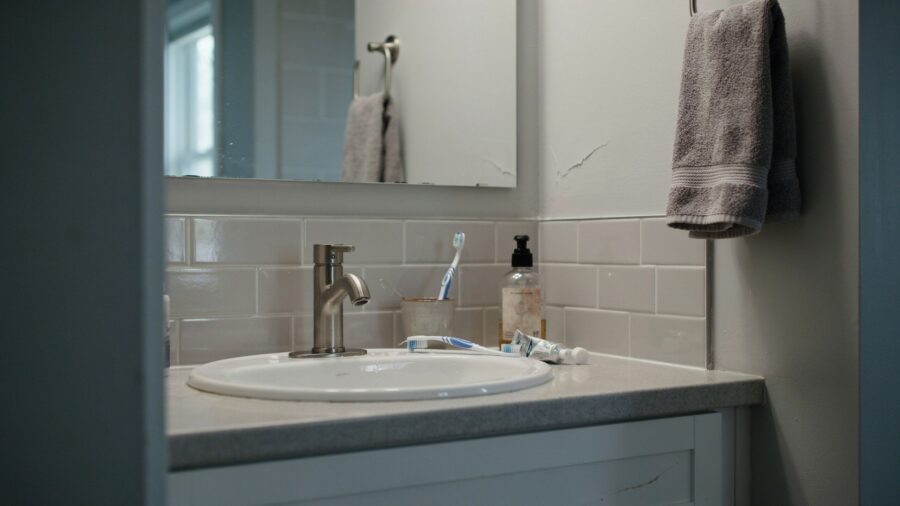
Walk into a hundred American bathrooms right now and you’ll see the same setup in most of them. A toothbrush lying flat on the counter. Or balanced on the edge of the sink. Or stuffed into a cup with two or three other brushes all touching each other. Or tucked into a drawer. Sometimes the toothpaste tube is sitting right next to the brush, cap off, nozzle inches from the bristles. Some look tidier than others. None of them are actually safer.
The twist most people miss: the habit isn’t one action you’re doing wrong. It’s a place. Where you set the brush down when you’re done is quietly the single biggest decision in your whole oral care routine, and it’s the one nobody thinks of as a decision at all.
Three separate things are happening to a toothbrush between uses, and the spot you’re keeping it in decides whether each one is harmless or a problem.
First, drying. The bristles stay wet for hours after you rinse. Wet bristles are exactly what germs need to multiply. The American Dental Association (ADA) puts it plainly: keeping a wet toothbrush in a closed container grows more germs than leaving it out in the open air. A brush lying flat on a wet counter, capped in a travel cover, or shoved in a drawer stays wet longer.
Second, contact. If your brush touches another brush, or the toothpaste tube, or the edge of the sink where splash water pools, it picks up whatever’s on those surfaces. A study on PubMed (a government database of medical research) found the germs that cause cavities living right on the opening of used toothpaste tubes. So every time your bristles press into that tube, they’re picking those germs back up. The ADA adds: if you keep more than one brush in a holder, keep them apart so germs don’t jump from brush to brush.
Third, the toilet. Another study, published in the International Journal of Dental Hygiene and cited by the ADA, found a common skin germ (the kind that can cause infections) on toothbrushes kept in bathrooms with a toilet, but not on ones kept in a bathroom without a toilet. The only difference was the room itself. Why? When you flush an open toilet, it shoots a fine invisible spray of water droplets into the air. Scientists call this a toilet plume. A team at the University of Colorado Boulder used lasers to actually film these plumes and found the droplets shoot out at 6.6 feet per second (about 2 meters/second) and rise almost 5 feet (1.5 meters) into the air within 8 seconds. Another study at Florida Atlantic University showed those droplets hang in the air for 20 seconds or more before landing. If your brush is on the counter within that range and the toilet lid is up when you flush, the spray lands right on your bristles.
The fix, and it costs under five bucks
If you read all that and thought, yep, that’s my bathroom, you’re not alone. Nearly everyone in that dental hygiene study said no one had ever told them how to store a toothbrush properly. It’s not a personal failing. It’s just a thing nobody talks about.
The fix comes straight from the ADA’s own guidance. Every step is either free or costs under $5 (roughly €5 or £4).
Stand your brush up, out in the open. The ADA says it plainly: keep your toothbrush upright after use and let it air dry. A little slotted holder on the counter works fine. A holder mounted on the wall is even better because it’s farther from sink splash.
Skip the closed cover and the drawer for daily use. Travel covers are for travel only. At home, they trap moisture and speed up germ growth. The Quinnipiac team found that covers actually make things worse, not better.
Keep every brush in the house apart from the others. Use a holder with separate slots so no two bristles touch. Two brushes leaning together in a cup all day is basically the same as sharing one brush.
Move your brush a few feet from the toilet, and close the lid before you flush. The Florida Atlantic study showed that closing the lid really does cut down the spray. If your bathroom is tiny and there’s no room to move the brush, closing the lid becomes the biggest thing you can do.
Don’t let the toothpaste tube touch your bristles. Squeeze the paste onto your brush without letting the tube nozzle actually touch it. Or switch to a pump-style dispenser. If more than one person shares the tube, this matters even more.
Rinse well, shake off the water, and swap the brush every 3 to 4 months. Shaking off the extra water helps the brush start drying the second you stand it up. Replace it sooner if the bristles look bent or frayed, since worn bristles hold more germs.
Under five bucks for a holder if you don’t have one. Two seconds to stand the brush up when you’re done. That’s the whole change, and it protects something you use about 700 times a year.
Worth remembering
You can brush like a pro, floss like a dentist’s kid, and rinse with the strongest mouthwash on the shelf. None of it lands the way it should if your brush is quietly picking up germs from three different places every time you set it down. The routine you’re proud of deserves a spot to rest that doesn’t undo it.
Sources: (1) American Dental Association, Toothbrush Care, Cleaning and Storage statement; (2) Quinnipiac University toothbrush contamination study, American Society for Microbiology, via ScienceDaily; (3) International Journal of Dental Hygiene toothbrush contamination study, via ADA News; (4) Contamination of toothpaste and toothbrush by Streptococcus mutans, PubMed; (5) University of Colorado Boulder toilet plume study, Scientific Reports (Nature); (6) Florida Atlantic University toilet aerosol study, Physics of Fluids; (7) Journal of the American Dental Association, Toothbrush care, cleaning and replacement.
The post You brush twice a day, floss, use mouthwash, and one toothbrush habit almost every home has is undoing all of it appeared first on Trendir.