

Before you blame your makeup for skin problems: even pro makeup users miss this
You wake up, look in the mirror, and there they are again. Two little bumps on your cheek. Maybe one on the jawline. Same spots as last week.
So you do the sensible thing. You blame the makeup. You switch your foundation. You Google “won’t clog pores.” You spend $34 (about €30) on a fancier concealer and promise yourself you’ll wash your face better at night. A week or two goes by. Nothing changes.
The strange part is that the more careful you get, the more it feels like your skin is fighting back. New cleanser, same bumps. Silk pillowcase, same bumps. You start wondering if it’s the water. Or your hormones. Or that one moisturizer everyone on TikTok said was gentle.
Meanwhile, the real thing making your skin worse is sitting on your vanity right now, in that cute little cup, looking totally harmless. It’s small. You use it every morning. It costs almost nothing to fix. And almost nobody thinks to blame it.
What your skin keeps trying to tell you
Think about where your breakouts actually are. Cheeks. Jawline. Sometimes the forehead. Now think about which parts of your face you touch every single morning with the same little tool, over and over, month after month. The pattern isn’t random. It’s a map.
Dermatologists have been trying to warn people about this for years, and the message just doesn’t stick because the culprit is so ordinary. The American Academy of Dermatology (AAD), the biggest group of skin doctors in the country, says the buildup on these tools can cause breakouts, rashes, and in worse cases, real infections like staph or E. coli. Board-certified dermatologist Dr. Annie Chiu told the AAD that this is one of the most common causes of skin trouble in people who otherwise take great care of their routine. Dr. Hadley King, another board-certified skin doctor, told NBC News that the mix of old product, oil, and dead skin sitting on the tool is what quietly feeds the acne in the first place.
Then the science teams got involved and started swabbing these things.
A 2025 study in the International Journal of Microbiology tested 57 used makeup brushes from real people. They found bacteria on almost all of them, including Staphylococcus (23% of samples) and Micrococcus (31%), plus some strains linked to skin infections. A separate 2025 study in PSM Microbiology looked at makeup tools from homes and salons and found Staphylococcus aureus on 42% of used brushes. That’s the same bug behind staph infections.
The same first study surveyed 370 makeup users about their habits. 44.3% said they rarely clean their tools. And 27.8% said they already suspected these tools were causing skin problems.
The tool doing the damage
You probably already had a small suspicion by now, and you’re right. The one doing the damage is your makeup brush.
Not because you bought the wrong one. Not because you’re doing your makeup wrong. It’s because of the way the internet has taught everyone to keep them, and one small step that almost every “vanity setup” guide skips right past.
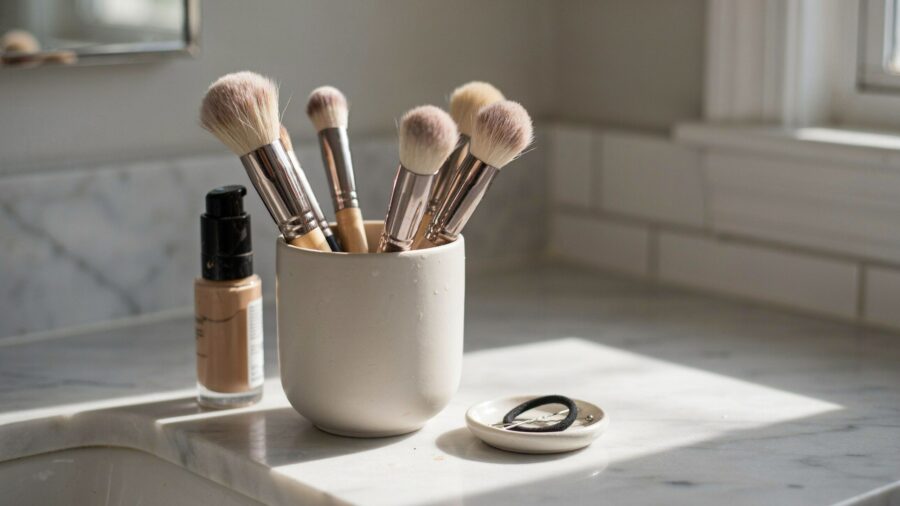
Somewhere in the last few years, “clean girl” content decided the right way to store brushes was to display them, bristles up, in a pretty ceramic cup on the counter. It looks like a magazine. It photographs beautifully. And it does nothing to keep them clean. Dust settles on the bristles all day. Bathroom air (especially near the toilet) carries tiny particles you don’t want on your face. Every morning you touch the brush to your skin, pick up oil and dead skin cells, and put it right back in the cup. Over a few weeks, that brush is basically a warm, damp buffet.
Even makeup artists get caught by this. Not because they don’t know better, but because the ritual of using the brush and putting it back looks and feels like the whole job. The visible part (nice tool, nice cup, nice vanity) is done. The invisible part is what gets skipped. And the invisible part is what changes your skin.
Displaying them was never wrong. Displaying them and never washing them was.
The small step nobody does
A brush cup is storage. It isn’t cleaning. Your brushes need a wash. On a schedule. The AAD’s official guidance is to wash makeup brushes every 7 to 10 days. For a face brush you use daily with liquid foundation or concealer, that’s the real cadence. Powder and eye brushes, which touch dry product and less oil, can stretch to every 2 to 4 weeks.
That’s it. That’s the missing step. Not a new brand. Not a fancier holder. A wash, on a Sunday.
If you’re reading this and thinking, yeah, I already knew I should do that, I just never do it, you’re exactly who the next part is for.
The Sunday brush wash
You need three things. Total: about $15 to $25 (roughly €14 to €23), one-time.
A silicone brush cleaning mat ($8 to $15 / €7 to €14 at Sephora, Ulta, or Amazon). A small bowl works too, but the mat cuts the time in half.
A gentle cleanser. Real Techniques Brush Cleansing Palette ($6 to $15 / €6 to €14), or plain Dr. Bronner’s castile soap. Mild, unscented. Skip anything with alcohol, it loosens the glue that holds the bristles in the metal ring at the top (that ring is called the ferrule).
A clean, flat towel.
Sunday night, at the sink:
Run the bristles under warm (not hot) water. Hot water melts the glue. Point the brush down so water flows away from the handle.
Add a small amount of cleanser to the mat, or to your palm.
Swirl the wet brush on the mat in small circles. The water will turn beige, or the exact color of your foundation. That’s a month of buildup in about 30 seconds.
Rinse until the water runs clear, still holding the brush pointing down.
Squeeze out the water gently with the towel, then reshape the brush head with your fingers.
Lay it flat on the towel overnight, with the bristles hanging just over the edge of the counter so air moves around them. Every pro brush-care guide, from Makeup.com to bkbeauty, warns against drying them upright in a cup because water trickles into the ferrule and the bristles start to shed. Dry flat. Only put them back in the cup once fully dry.
Set a repeating Sunday reminder on your phone. That’s the whole trick. Not motivation, a reminder.
Whole thing: 5 to 10 minutes for a full set, once a week.
What actually changes
Once you’re on the weekly rhythm, two things happen. Within a couple of weeks, the little bumps on your cheeks and jawline start to fade, because you cut off the bacteria feeding them. And your brushes last for years instead of months.
Displaying your brushes is what makes your morning feel nice. Washing them on Sunday is what makes your skin actually get better. The setup was never the problem. The missing step was.
Sources: (1) American Academy of Dermatology, How to clean your makeup brushes; (2) Attar RMS, Imam MA. Assessing the Levels and Types of Bacterial Contamination in Cosmetic Brushes, International Journal of Microbiology, 2025; (3) Al-Mekhlafi NA, Dahaba AL. Isolation and Identification of Bacteria from Some Used Makeup Tools in Sana’a City, PSM Microbiology, 2025; (4) American Academy of Dermatology press release featuring Dr. Annie Chiu, MD, FAAD; (5) NBC News, Dr. Hadley King on makeup brush hygiene; (6) Makeup.com, How to dry makeup brushes the right way; (7) bkbeauty, Brush care guide.
The post Before you blame your makeup for skin problems: even pro makeup users miss this appeared first on Trendir.