

The gap between a chef’s knives and yours is a fifteen-dollar tool, not skill, and not the sharpener you own
Watch a chef pull a knife off the magnet and start cooking. The blade glides. Onions fall into ribbons. Tomatoes barely notice the knife’s there. Then picture yourself at home, sawing at the same tomato with a knife that felt razor-sharp last month, and the same thought hits: what are they doing that I’m not?
You’ve probably guessed knife skills. Or expensive Japanese steel. It’s none of those. The single biggest thing separating a chef’s edge from yours costs about fifteen dollars (roughly €14), lives on a hook near the stove, and takes ten seconds to use. Almost nobody at home owns one. And the thing sitting on your counter, the one you thought was helping, has quietly been making the problem worse for years.
Your knife isn’t dull the way you think it is
Look at a brand-new chef’s knife under a microscope and the edge isn’t smooth. It’s a row of tiny points, like a saw so fine you can’t see it. Knife makers call these microscopic teeth. They’re what actually cut into a tomato skin or a chicken thigh.
Made In, the American cookware brand, puts it in plain terms: those tiny teeth naturally get bent out of shape every time you cut. It happens to every knife, from a ten-dollar (roughly €9) grocery-store one to a three-hundred-dollar (roughly €280) Japanese one. The teeth don’t fall off and they don’t wear down. They just fold over sideways, so the pointy parts stop pointing at your food.
That means a knife that feels dull is almost never actually dull. It’s just crooked. Wüsthof, the German knife maker in Solingen that’s been making blades for over 200 years, says the same in its care guide: the right tool straightens those microscopic teeth you can’t see with the naked eye, and doing it often means you almost never need to sharpen the knife itself.
So why do your knives keep going dull? And why don’t a chef’s?
What working chefs do that you probably don’t
Walk through any restaurant kitchen and you’ll spot it in a minute. Between tasks, cooks pick up a tool from the station, run their blade against it four or five times per side, and get back to work. Ten seconds. It looks like showing off. It isn’t.
Notice what’s missing: no sharpening, no grinding, no gadget on the counter. A working chef might go a full year without ever actually sharpening a knife on the line. The trick isn’t more sharpening. The trick is that quick daily upkeep that takes almost no time and takes off almost no metal.
Now compare that with what most people do at home. When a knife starts dragging on an onion, you reach for the tool you were told would help. You pull the blade through it a few times, feel the edge come back, and put it away. Problem solved, or so it seems.
The trouble is, that tool isn’t doing what a chef’s tool does. It’s doing something almost the opposite. Every time you use it, your blade quietly gets a little worse.
Think about it this way. A chef who cooks on the same knife every day for years doesn’t burn through blades. A home cook who cooks a few times a week burns through a good knife in a year or two. That gap isn’t about how hard chefs use their knives. It’s about what they don’t do to them.
The small plastic gadget that’s quietly wrecking your knives
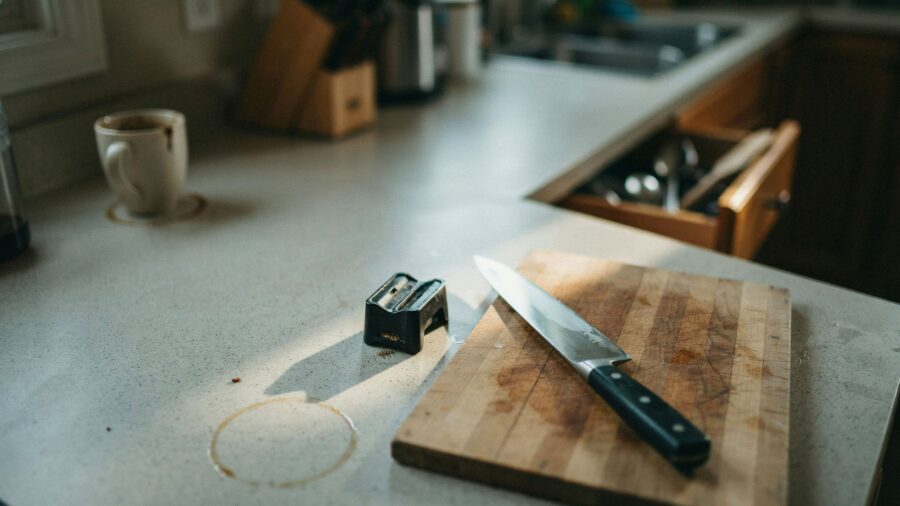
The tool doing the damage is the pull-through sharpener, the small plastic unit with two V-shaped slots and little wheels inside. It sits on almost every American kitchen counter. And it doesn’t straighten anything on your blade. It grinds, on both sides at once, at whatever angle the maker picked, usually around 20 degrees, whether your knife was built for that angle or not.
People who sharpen knives for a living have measured what comes off. According to Seriously Fast Sharpening, a professional knife service, pull-throughs take off roughly 2 to 3 millimeters (about 0.08 to 0.12 inches) of metal every time you use one, versus about 0.5 to 1 millimeter (about 0.02 to 0.04 inches) from a proper stone sharpening. Run yours through weekly for a year and the math gets ugly.
Chef’s Armoury, a professional sharpening shop, adds that pull-throughs can’t press evenly along the whole blade. The edge goes out of shape and the original shape gets permanently changed. A Japanese knife built for a 15-degree edge gets forced to 20 degrees and loses the shape that made it slice cleanly.
America’s Test Kitchen, the U.S. cookware review outfit that tests tools harder than almost anyone else, calls the frequency itself the real mistake. Their rule: quick tune-ups often, real sharpening rarely. Running a knife through a pull-through every week, in their testing, over-does it and shortens your knife’s life for no reason.
The fifteen-dollar tool sitting on every chef’s station
That long metal rod hanging within arm’s reach of every working cook is a honing rod (sometimes called a honing steel). It does one job: it pushes those bent microscopic teeth back into a straight line. No metal removed. No angle changed. No damage to the blade.
A basic ceramic or steel honing rod runs about $12 to $20 (roughly €11 to €18) at any kitchen store. Wüsthof and Henckels, the two big German knife brands, both sell them and both tell customers to use one before every cooking session. America’s Test Kitchen’s instructions: stand the rod tip-down on your counter, hold your knife at about a 15-degree angle from the rod, and slide the blade down the rod from heel to tip. Four or five strokes per side. Total time in their testing: about one minute for a tune-up, versus five for actual sharpening.
Do that before you start cooking, and your knife will feel freshly sharpened, because in every way that counts, it is.
Then, once or twice a year, when a quick tune-up stops bringing the edge back, take your knife to a whetstone or a local sharpening shop (usually $10 to $15, or about €9 to €14, per knife) for real sharpening. That’s the whole system. Tune up often, sharpen rarely, and the plastic gadget never enters the picture again.
What to do differently, starting tonight
If your knives have already been through a pull-through, that damage is done. But the ongoing wear stops the second you switch.
Buy a basic honing rod. A ceramic one is forgiving for beginners and works on soft or hard steel. Length should be at least two inches (about 5 cm) longer than your longest knife.
Use it before every cooking session. Rod tip on the counter, knife tilted at roughly 15 degrees from the rod (about two stacked quarters thick), heel to tip, four or five slow strokes each side. Ten seconds, done.
Retire the pull-through. Toss it or stick it in a drawer. Every extra pass grinds off metal you’ll never get back.
Get real sharpening once or twice a year. A local knife shop or mail-in service handles it cheaply. Skip electric pull-throughs too, since they take off metal even faster.
Test on a tomato, not paper. A dulling knife often still slices copy paper cleanly, then fails on tomato skin. If the skin fights back, it’s time for a quick tune-up.
The University of Rochester Medical Center notes that a dull blade needs more force to cut, raising the chance your knife slips with real weight behind it. Sharp knives are safer, too.
Sources: (1) Made In — Honing vs. Sharpening; (2) Wüsthof / Knife Merchant — Deluxe Honing Rod care guidance; (3) Seriously Fast Sharpening — Pull-Through Sharpener Damage; (4) Chef’s Armoury — Truth About Pull-Through Knife Sharpeners; (5) America’s Test Kitchen — Knife Tune-Up: How to Use a Honing Rod; (6) America’s Test Kitchen — How to Sharpen Kitchen Knives; (7) University of Rochester Medical Center — Be Careful with Kitchen Knives.
The post The gap between a chef’s knives and yours is a fifteen-dollar tool, not skill, and not the sharpener you own appeared first on Trendir.