

Wearing outdoor shoes inside is ruining your home’s air and floors: the 5-minute fix every entryway needs
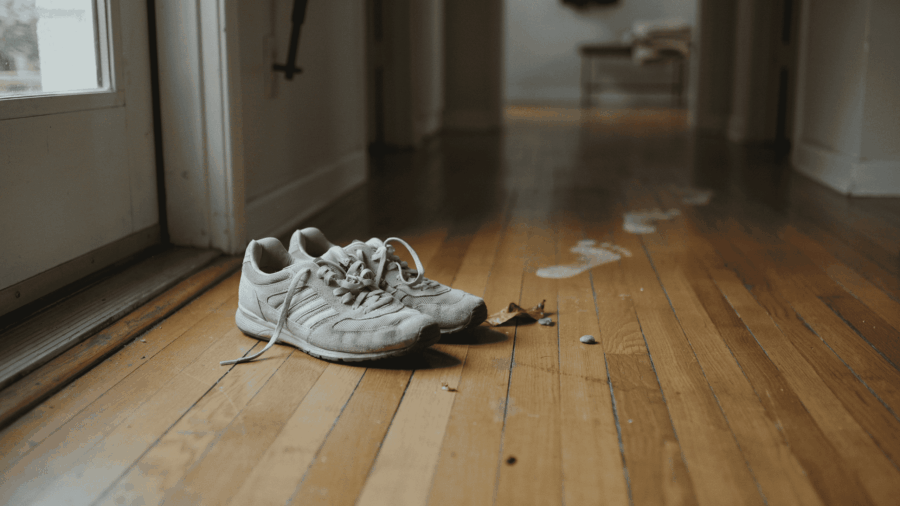
You mop the floors. You run the vacuum. You wipe down the counters. And still, the air in your house feels off. The rug near the front door looks worn out after a year. The baseboards get grimy way faster than they should. It isn’t your cleaning. It’s what walks in your front door every single day, without you noticing, and settles into every room you use.
The one spot in your house doing most of the dirty work
Almost nobody thinks about this, but the floor right inside your front door is doing more cleaning work than your vacuum is. Every step across it drops something behind. And whatever gets dropped there doesn’t stay put. It gets pushed into the carpet fibers, kicked into the air, and carried on socks and paws deeper into the house.
A December 2025 home health guide from the University of Georgia Cooperative Extension, written by their indoor environment specialist Pamela Turner, gives the number that stops most people cold: 30% to 40% of the dust inside your home was tracked in from outside. [1] Not from cooking. Not from your skin or your pets shedding. From outdoors.
Why your cleaning routine can’t keep up
The same guide points to something even more surprising from U.S. Environmental Protection Agency (EPA) research: the first four steps you take inside your front door bring in close to 85% of the outdoor stuff that ends up in your home. [1] Four steps. That’s the whole game, right there.
Think about what that means. You can vacuum every day. You can mop twice a week. You can buy the fanciest air purifier on the market. But if what’s coming in the front door is landing in your carpet faster than you can clean it out, you’re always going to be behind. The rug near the door wears out first. The baseboards grey up first. The air in the room closest to the front door feels heaviest.
And it isn’t just “dirt” you’re bringing in. If it were regular dirt (from a garden or a walking trail), it would vacuum up fine and you’d never notice. What’s really tracked in every day is something much smaller, much harder to clean, and much more of a problem for anyone in the house with allergies, asthma, or small children who sit on the floor.
Here’s the part almost nobody talks about: what’s on the bottom of your shoes when you walk in the door isn’t just dust. It’s a stack of things you would never willingly bring into your kitchen.
What’s really on the bottom of your shoes
Fecal germs, in huge numbers. Dr. Charles Gerba, a germ researcher at the University of Arizona, tested shoes worn for about two weeks. Each shoe carried an average of 421,000 germs on the outside. [2] Ninety-six percent of the shoes tested positive for gut germs (the kind that come from human or animal waste, including E. coli). About one in four shoes had E. coli itself. And when a shoe stepped on a clean tile, 90% to 99% of those germs transferred right onto the floor. [2]
C. difficile, or C. diff, is a serious gut bug most people connect with hospitals. It’s on shoes too, at rates that surprise doctors. Researchers at the University of Houston College of Pharmacy tested 30 Houston homes and found C. diff on about 40% of the shoes they sampled. [3] Shoes were the dirtiest thing in the whole house. Dirtier than bathroom surfaces.
Lawn weed killer. If a neighbor sprays the yard, or a crew treats a nearby park, you’re the delivery driver. A team led by scientist Marcia Nishioka at Battelle Memorial Institute, working under an EPA grant, followed a common lawn weed killer (called 2,4-D) into 13 Ohio homes after it was sprayed on the grass. More than 70% of the weed killer that ended up inside those homes came in on shoes and pet paws. [4] The amount on living room floors jumped about 12 times higher in the week after the spraying.
Lead. The EPA’s official advice on lead is short and blunt. Put doormats inside and outside every entryway, and take shoes off before coming in, so you don’t track lead-poisoned soil into the house. [5] Any home built before 1978 sits in a yard where old lead paint may have flaked into the dirt. And no amount of lead is considered safe for kids.
Dr. Anita Shallal, an infectious disease doctor at Henry Ford Health in Detroit, said the same thing in a 2024 hospital guide. “No amount of lead is considered safe,” she wrote, and shoes are one of the main ways it comes in. She recommends a shoes-off house, a bench at the door, and slippers for guests. [6]
If you read all that and thought, that’s basically me, I wear my outdoor shoes right into the kitchen, you’re not alone. It’s the American default. It’s also easy to fix.
The 5-minute fix that stops most of it at the door
The University of Georgia guide, pulling from EPA research, gives the number that matters: when you use a doormat and take shoes off at the door, lead dust and other chemicals inside your home drop by about 60%. [1] Add in the “first four steps” finding, and it means the vast majority of what’s making your indoor air stale and your floors dingy can be stopped in one small spot: the six square feet (about half a square meter) just inside your front door.
You don’t need a renovation. You need a boundary. A place where outdoor shoes come off and stay off. You can set it up in about five minutes, for $0 to $30 (roughly €0 to €28).
Do this:
Put a mat outside the door. A rough, bristly, or rubber-grate one, big enough for a person to take two full steps across. This scrapes off the loose stuff before it ever hits your front door.
Put a second mat just inside the door. A soft, absorbent one that grabs the fine dust and moisture the outside mat missed. The University of Georgia and EPA both call this the single most effective step you can take to cut indoor dust. [1]
Add a sitting spot. A small bench, a sturdy stool, even a folded blanket on a step. If people have somewhere to sit, they’ll take their shoes off. If they don’t, they walk right through the house.
Add a shoe basket or rack next to the bench. Outdoor shoes stop here. That’s the rule.
Keep a small basket of indoor slippers or clean socks. For you, your family, and a spare pair or two for guests. Warm feet make the rule stick.
Clean both mats often. A dirty mat becomes a source instead of a filter. Vacuum weekly, and hose the outside one down every couple of weeks.
That’s it. No apps. No pricey gadgets. Just a $10 mat (about €9) and a bench you probably already own.
Sources: (1) University of Georgia Cooperative Extension, Circular 1070, “Reduce Indoor Contaminants: Leave Your Shoes at the Door” (Dec 2025); (2) Charles P. Gerba / University of Arizona / Rockport shoe bacteria study, summarized by the Cleaning Industry Research Institute; (3) Alam MJ, Anu A, Walk ST, Garey KW. “Investigation of potentially pathogenic Clostridium difficile contamination in household environs.” Anaerobe, 2014; (4) Nishioka MG et al. “Distribution of 2,4-Dichlorophenoxyacetic Acid in Floor Dust throughout Homes Following Homeowner and Commercial Lawn Applications.” Environmental Science & Technology, 1999; (5) U.S. Environmental Protection Agency, “Protect Your Family from Sources of Lead”; (6) Henry Ford Health, “Should You Take Your Shoes Off In The House?” reviewed by Dr. Anita Shallal (2024).
The post Wearing outdoor shoes inside is ruining your home’s air and floors: the 5-minute fix every entryway needs appeared first on Trendir.