In my previous article, I wrote briefly about my general impression of Venice and my visit to the Arsenale exhibition: Biennale Arte 2026 | A Few Favourites from the Arsenale Looking back on my week in Venice and the Biennale, what I enjoyed most, much like during the Salone in Milan, was the opportunity to step into places that are usually off limits. Moreover, the journey to each of these locations always involved a walk through charming, lesser known parts of the city. I can truly say that I thoroughly enjoyed Venice. Having been born on a canal in Amsterdam and now living on the islands in Amsterdam’s Eastern Docklands, I have always been surrounded by water; this is undoubtedly one of the reasons why I felt so at home in Venice.
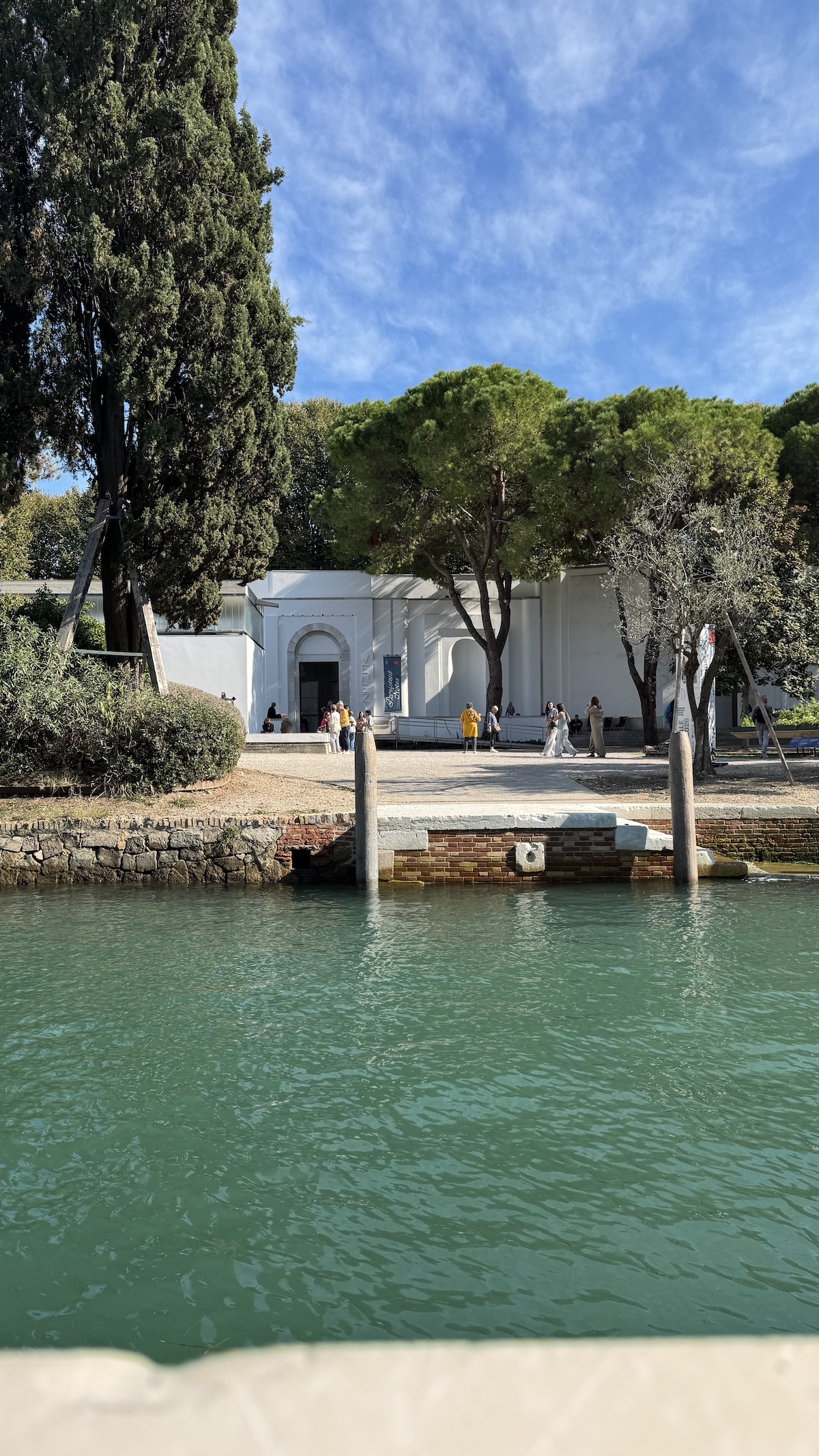
After spending most of the day at The Arsenale, the next day we went to The Giardini, the second main location of the Biennale. The Giardini is the historic home of the Venice Biennale, where the first international art exhibition took place in 1895. At first, artists from different countries exhibited together in one building. As the Biennale grew, countries began building their own national pavilions, starting with Belgium in 1907. Today, the gardens contain 29 national pavilions, built at different times and designed by different architects.
Each pavilion represents a participating country, which selects its own artists and curators for the exhibition. This is why the pavilions are all different: each country develops its own exhibition, with its own subject, approach and way of presenting art. The buildings themselves are also part of the experience, ranging from historic structures to modernist architecture. Not every participating country has a pavilion in the Giardini, so others exhibit at the Arsenale or in venues around Venice. I really loved The Giardini and the different styles of each pavilion.
We visited every pavilion here, in some we stayed a bit longer, and some we left after a quick scan. The Dutch pavilion was closed despite checking opening days. And the probably most mentioned Austrian pavilion had a two-hour queue, we did arrived just in time for the performance part of the Austrian Pavilion, where a female performer climbs a rope and uses her body to ring the bell hanging outside the pavilion. I selected a few of my favourites from the Giardini and will start with my absolute favourite exhibition in the Belgian Pavilion which really touched me, I filmed almost the entire performance, including Wietse Tanghe’s beautiful singing voice
More from the Giardini can be found on my Instagram in the Venice Highlight
Belgium
With IT NEVER SSST, Miet Warlop transforms the Belgian pavilion into a charged arena where language, music and collective disorientation collide. Plaster words circulate through the space: carried, passed along, dragged and broken. Musical characters sing and search for meaning within these unhinged fragments, which together form the lyrics and emotional score of this exhibition-performance. A group of musicians and dancers move through a turbulent atmosphere marked by a growing sense of doom. Through a series of absurd and physical rituals, they keep going, resisting resignation and stillness.
This vision of the world mirrors our own, wavering between despair and the urge to transcend it into something meaningful and more beautiful. Warlop’s high performing, energetic and creative characters grapple with the threat of overload, at times revealing their breaking points. They navigate a spiralling world in which words themselves lose stability and sing towards that vulnerable threshold in a language that is felt rather than understood. The pavilion is never fully silent, even when the performance ends. The words left behind resonate as a poetry of chaos. Scattered across tribunes that climb the walls, they stand frozen in time. Like remnants of a prayer wall or a karaoke machine from a vanished civilisation, they await new voices in pursuit of human connection. TXT Biennale official site
Commissioner: Caroline Gennez, Flemish Minister for Welfare and Poverty Reduction, Culture and Equal Opportunities
Curator: Caroline Dumalin (MORPHO)
Exhibitor: Miet Warlop
Brazil
The Brazilian Pavilion presents Comigo ninguém pode, bringing together artists Rosana Paulino and Adriana Varejão. The title refers to a plant commonly found at the entrances of Brazilian homes, where it is associated with spiritual protection. Through new, historical and previously unseen works, the exhibition explores the relationship between spirituality, nature and colonial history, bringing together different perspectives on faith, cultural memory and the reinterpretation of colonial histories.
Commissioner: Andrea Pinheiro, President of Fundação Bienal de São Paulo
Curator: Diane Lima
Exhibitors: Rosana Paulino and Adriana Varejão
Japan
The Japanese Pavilion presents Grass Babies, Moon Babies by Ei Arakawa-Nash, bringing together artmaking, parenting and collective care. Visitors begin by holding one of 200 baby dolls before moving through the garden and into the pavilion, where a sound piece featuring the artist’s twin babies accompanies screens showing historical and contemporary films that explore Japanese identity and diasporic experiences. Near the exit, visitors can change a doll’s diaper and receive an oracular poem through a QR code, linking the act of care to the histories of Japan, the United States and Asia.
Commissioner: The Japan Foundation
Curators: Lisa Horikawa, Mizuki Takahashi
Exhibitor: Ei Arakawa-Nash
A few random images from The Giardini – The French Pavilion
The French Pavilion
Scandinavian Pavilion
American Pavilion… we ran out as it was really cold inside because of AC
Collateral events and exhibitions
Beyond the main exhibition venues at the Giardini and Arsenale, Biennale Arte 2026 also extends into Venice through a series of collateral events and exhibitions across the city. These projects take place in different settings, from historic palazzi to churches and other independent venues. I visited two exhibitions outside the main Biennale grounds that offered another perspective on contemporary art during In Minor Keys.
Official. Unofficial. Belarus
The Breath You Hold explores life in contemporary Belarus through an immersive installation combining scent, sound and movement. Altar candles release a fragrance recalling prison corridors, forged documents and unmarked graves, while a soundscape by Olga Podgayskaya transforms liturgical music into near silence. The exhibition also includes Taste of Nothing, a work by chef Rasmus Munk, offered at designated times. Together with works by artists Sergey Grinevich, Vladimir Tsesler and Nicolai Khalezin, the exhibition addresses surveillance, censorship and the loss of privacy.
Curators: Daniella Kaliada, Natalia Kaliada
Exhibitors: Sergey Grinevich, Nicolai Khalezin, Vladimir Tsesler, Rasmus Munk
Venue: Chiesa di San Giovanni Evangelista, San Polo 2454
Su Xiaobai
Su Xiaobai’s Alchemical Universe presents 23 lacquer paintings by Chinese contemporary artist Su Xiaobai, spanning works from 2009 to the present, alongside his first lacquer painting made in Fujian in 2003. The exhibition includes twelve works from his recent Niao Niao series, featuring monochromatic surfaces and subtle tonal variations that recall classical Chinese ink painting. Using layers of lacquer, pigments and metals, Su explores the material qualities of the medium through surfaces that are built up and then abraded.
Curator: Stephen Little, Curator of Chinese Art and Head of the Chinese, Korean, and South and Southeast Asian Art
Exhibitor: Su Xiaobai
Venue: Palazzo Soranzo Van Axel, Cannaregio 6099
Images ©vosgesparis
This article is part of The Collectible Edit
Support independent design curation
Since 2007, vosgesparis has been an independent space for design enthusiasts worldwide. If you love following my travels to international design fairs and exhibitions, consider supporting my work with a small gesture. A virtual coffee helps cover the independent travel costs behind the scenes.
[Buy me a coffee & support vosgesparis]
vosgesparis is an independent online interior design magazine with an international focus.
For features, brand collaborations or sponsored projects, see how to work with vosgesparis.
Het bericht Biennale Arte 2026 | Favourites from the Giardini and downtown Venice verscheen eerst op vosgesparis.