

You can clean your kitchen perfectly and still spread germs everywhere, because of one item
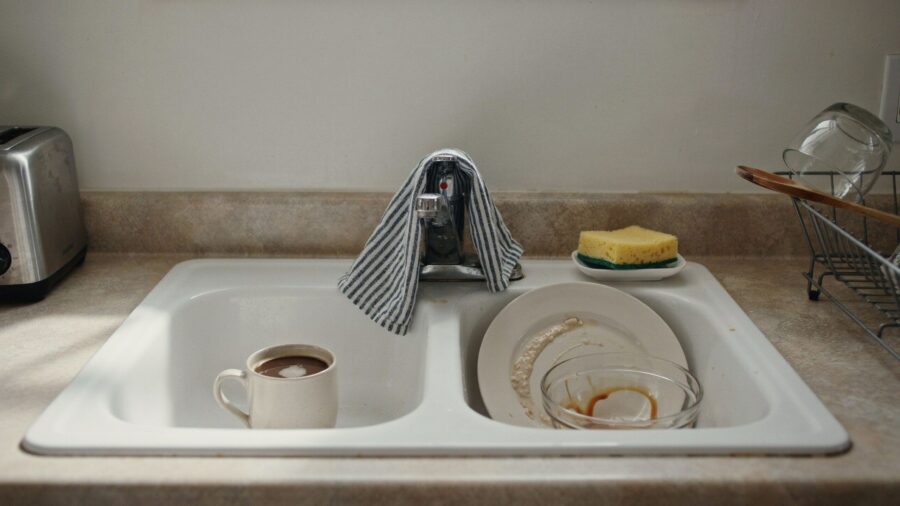
You wiped the counters. You washed the dishes. You even hit the cutting board with hot, soapy water. Your kitchen looks clean.
But there’s a decent chance it isn’t. Not really.
There’s one everyday thing sitting in almost every American kitchen right now that quietly undoes a lot of that work. It’s cheap. You touch it every single day. You probably used it in the last hour. And the science on it is honestly a little gross.
Stick with me, because the fix takes about a minute a day and costs less than two dollars a month (around 1.80 euros). But first, the part nobody tells you.
The germiest spot in your house isn’t the toilet
Most people, if you ask them, would guess the toilet. Or maybe the trash can. Something in the bathroom, anyway.
They’d be wrong.
Back in 2011, a public health group called NSF (short for National Sanitation Foundation) sent testers into 22 real family homes and swabbed 30 different spots in each one. The single germiest item in the whole house was something in the kitchen. Over 75 percent of the samples from that one item came back positive for coliform bacteria, the family of bugs that includes E. coli and Salmonella. For comparison, only 45 percent of the kitchen sinks and 18 percent of the cutting boards tested positive. That one item beat both, badly.
Then in 2017, a German scientist named Markus Egert at Furtwangen University took it further. His team collected 14 of these items from regular households and did full DNA analysis on them, basically reading the genetic code of everything alive inside. They found 362 different kinds of bacteria packed in there, at levels of up to 54 billion germs per cubic centimeter (about the size of a sugar cube). That’s roughly the same amount of bacteria you’d find in a sample of human poop. Five of the ten most common types were the kind that can actually make you sick, especially kids, older folks, and anyone with a weaker immune system. The study was published in Scientific Reports.
A separate study out of Duke University in 2022 asked why this one everyday item is so much worse than everything else. The answer surprised the researchers. It isn’t just the food bits and the moisture. It’s the actual shape of the thing. All those tiny holes and bigger open pockets give different kinds of bacteria their perfect living conditions all at once. Their study, in the journal Nature Chemical Biology, found this item grows a bigger variety of bacteria than the special lab dishes scientists literally design for growing bacteria.
Which is a strange thing to say about an object most of us buy in a three-pack at the grocery store for a couple of bucks.
It’s your kitchen sponge
That’s the item. The one sitting in your sink right now.
The same sponge you use to wipe down the counter after cutting raw chicken. The same one you use for last night’s plates. The same one that sits damp between jobs.
You might be thinking: okay, but I rinse mine after every use. I squeeze it out. Sometimes I even throw it in the dishwasher. That should be fine, right?
This is where it gets frustrating. Karen Fifield, a food safety educator at Michigan State University Extension, puts it plainly: your sponge lives in the exact temperature and moisture range that bacteria love. Not too hot, not too cold, always a little damp, and always covered in tiny food bits that bacteria eat. It’s basically a bacteria hotel.
And that same 2017 German study noticed something the researchers didn’t expect. Sponges that people said they cleaned regularly didn’t actually have fewer bacteria than dirty ones. In some cases, the “cleaned” sponges had more of the concerning types. Egert’s team ran a follow-up in 2020 in the journal Microorganisms: 20 households, brand new sponges, half of the group microwaved theirs on a schedule for four weeks. The microwaved sponges shifted toward tougher bacterial groups like Acinetobacter, Klebsiella, and Pseudomonas, some of which can cause real infections.
Why? The tough survivors are tougher. Kill off the wimpy bacteria and you leave more room for the hard-to-kill ones to move in. Same basic idea as when overusing antibiotics creates super-bugs, just at a tiny scale on your countertop.
So if you’re doing what most of us do (a quick rinse, a squeeze, maybe a dishwasher spin every so often, and then the same sponge for weeks) you’re not fixing this. You might actually be making it worse.
Good news: there’s a real fix. It has two parts, and most people only ever do one.
The fix that actually works
Part one: sanitize between the dirty jobs. The USDA (that’s the US Department of Agriculture) ran a lab test on kitchen sponges. Microwaving a fully soaked sponge on high for one minute killed 99.9999 percent of the bacteria. Running it through a hot dishwasher cycle with the heated drying phase killed 99.9998 percent. Bleach soaks, lemon juice, and plain water were all way behind. Safety rules: the sponge has to be soaking wet before it goes in the microwave (a dry sponge can catch fire), and it can’t have any metal scrubbing fibers.
Part two, and this is what almost nobody does: replace the sponge on a real schedule. The USDA itself says sanitizing “may reduce some of the bacterial load,” but it isn’t enough on its own to stop germs from spreading between the sponge, your hands, your counters, and your food. Their advice is to buy new sponges often. Zahra Mohammad, a food scientist at the University of Houston who works with the American Society for Microbiology, throws hers out every single week. Egert (the German researcher) says the same. NSF’s guidance is every two weeks, sooner if it smells at all.
Sanitize without replacing, and you breed tougher germs. Replace without sanitizing, and the load builds up between changes. You need both, and it costs about two dollars a month.
The checklist worth taping inside your cabinet:
Soak the sponge fully and microwave it on high for one minute every night after the last dish is done. No metal, no dry sponges. Let it cool for a minute, it comes out really hot.
Or run it in the dishwasher on a full hot cycle with heated drying, at least every other day if you use it a lot.
Wring it out and stand it somewhere it can dry. A sponge slumped at the bottom of a wet sink stays wet, and wet is what bacteria need. A wire caddy on the sink edge works great.
Throw it out every week if you use it daily. Two weeks is the outside limit. Any smell means it’s already too late.
Never use the same sponge for raw meat and eating surfaces. Keep a separate one, or a paper towel, for the raw-meat cutting board.
Think about a dish brush for heavy scrubbing. Bristles dry way faster than sponge foam, so bacteria have a harder time growing. Sponge for wiping, brush for scrubbing.
The point worth remembering
Your kitchen can look totally clean and still be quietly spreading germs on every surface you wiped down. Not because you didn’t clean, but because the thing you cleaned with was hiding more bacteria than the mess it was picking up. Fix that one item, on a real schedule, and everything else you’re already doing finally starts to count.
Sources: (1) NSF International 2011 Household Germ Study; (2) Cardinale, Egert et al., Scientific Reports, 2017; (3) Wu, You et al., Nature Chemical Biology, 2022 (Duke University press release); (4) Michigan State University Extension, food safety guidance; (5) Jacksch, Egert et al., Microorganisms, 2020; (6) USDA Agricultural Research Service, Sharma & Mudd sponge sanitation study, 2007; (7) Clemson Cooperative Extension, kitchen hygiene fact sheet.
The post You can clean your kitchen perfectly and still spread germs everywhere, because of one item appeared first on Trendir.