

She took out the trash but the kitchen still smelled, until she found what everyone forgets to clean
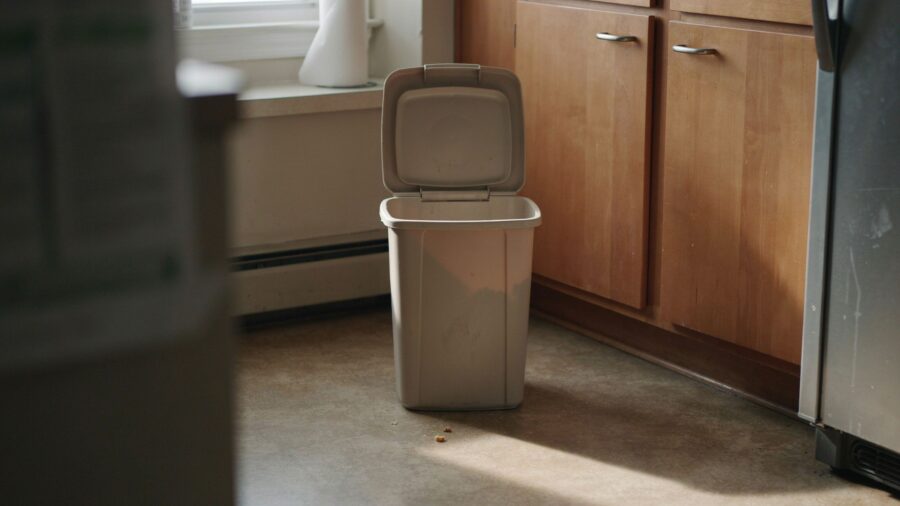
She’d done everything right. Tied the bag, walked it to the curb, dropped in a fresh one, snapped the lid shut. Then she walked back into the kitchen and the smell was still there. Faint, sour, and there was no getting away from it. Hanging in the air like the trash had never left.
If that sounds familiar, you’re not imagining it, and you’re not doing anything wrong on the surface. Most of us learned the same drill as kids. Tie the bag, take it out, pop in a new one. Done.
Except the smell keeps coming back. Sometimes within hours. Sometimes the second you lift the lid to toss something else in.
The habit that quietly makes it worse
Here’s the strange part. The tighter you seal the lid to hold the smell in, the worse it tends to get over time. That instinct to clamp it down feels right. It’s actually part of what’s feeding the problem.
Think about what’s in that bag. Food scraps are mostly water. Meat drippings, coffee grounds, wilted lettuce, that last spoonful of yogurt you scraped out. The moment you seal all that up in a warm, closed space with no air moving through it, one specific kind of bug takes over. The kind that grows without oxygen.
And these bugs don’t just quietly break food down. They pump out some of the worst-smelling gases in nature.
What the science says (and it’s not pretty)
This isn’t guesswork. When food waste breaks down without air, it gives off three big stinkers: the rotten-egg gas (hydrogen sulfide), an ammonia smell like a dirty diaper, and a sour, vinegary smell from acids the bacteria make. A study in the science journal GCB Bioenergy confirms that the rotten-egg gas is one of the nastiest byproducts when food waste rots without air (1).
Research published in Nature Scientific Reports backs this up, tracing those specific stink chemicals straight back to the bacteria growing on everyday food scraps like meat and vegetables (2).
And this next part matters. Food that breaks down with air moving through it barely smells. Food that breaks down in a sealed bin smells terrible. So every time you clamp that lid down, you’re building up smell in a small, warm chamber for hours, until the next time you lift the lid and it hits you all at once.
But sealing the lid isn’t the whole story. There’s a second half almost everyone misses.
Why a fresh bag doesn’t fix it
Even after you tie off the trash and drop in a brand new bag, the smell often stays. That’s because the smell isn’t really coming from the trash anymore. It’s coming from somewhere the bag never touches.
Every bag leaks a little. A drop of meat juice down the side. A splash of soup when you push the bag down to squeeze more in. Coffee grounds through a small tear. Over weeks and months, those tiny leaks build up on the inside walls and floor of the bin, forming a thin, sticky film. Bacteria settle into that film and don’t leave.
Scientists call this a slime layer. It’s held together by a kind of natural glue the bacteria make around themselves, and once it’s there, a quick rinse with water won’t remove it. The U.S. Environmental Protection Agency has written about this same problem inside water pipes, noting that these slime layers can hide bacteria and protect them from normal cleaning (3). The same thing happens on the inside walls of your trash can.
So the smell in your kitchen isn’t your trash bag. It’s the surface underneath it. The one spot most people never look at, let alone clean.
That’s what everyone forgets. And that’s the fix hiding in plain sight.
The five-minute reset that actually works
Once you know the real enemy is the inside of the bin itself, the fix is almost embarrassingly cheap and quick. Under a dollar (about €1) in soap. Less than five minutes of real work. Done once every two to three weeks.
Do this:
Empty the bin all the way. Take the bag out, tie it off, get it to the curb.
Wash the inside with warm water and dish soap. Any dish soap you already own works. Grab a sponge or an old rag and really get into the corners and the seam where the bottom meets the wall. That seam is where the gunk collects most. Scrub for about a minute, not just a quick wipe. You’re trying to physically break up that sticky film, not just make it wet.
Rinse with warm water. Pour it in, swish it around, dump it out. If the smell is really set in, sprinkle in a couple of tablespoons (about 30 grams) of baking soda first, add warm water, and scrub.
Spray the inside with an antibacterial cleaner. Any household disinfectant spray will do. Let it sit for the few minutes the label tells you to, then wipe it off.
Let it dry all the way in the open air. This is the step almost everyone skips, and it’s the most important one. A damp bin wakes those bacteria right back up within hours. Set the can outside or by an open window, lid up, until the inside is bone dry to the touch. Usually about an hour.
Then put in a fresh bag. Not before.
Do this every two or three weeks and the smell doesn’t come back. Not because the trash changed, but because the surface it was living on is finally gone.
Why this changes everything
Next time you lift your lid and get hit with that stale, sour wall of air, remember what’s really going on. The bag left. The bacteria didn’t. A tight lid holds the smell in the same way a lid on a pot holds steam. It doesn’t stop the steam. It just decides when it hits you.
Sources: (1) Characterizing and modeling hydrogen sulfide production in anaerobic digestion, GCB Bioenergy (Wiley); (2) Inoculation with black soldier fly larvae alters the microbiome and volatile organic compound profile of decomposing food waste, Scientific Reports (Nature); (3) Biofilms in Drinking Water Distribution Systems, U.S. Environmental Protection Agency Science Inventory.
The post She took out the trash but the kitchen still smelled, until she found what everyone forgets to clean appeared first on Trendir.