

Your toothbrush is probably dirtier than you’d ever want to know: and no, cleaning it isn’t the answer
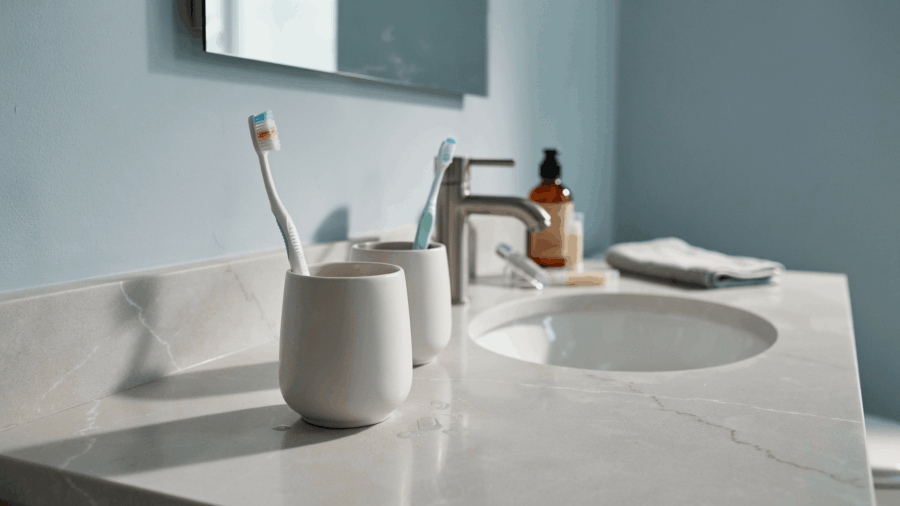
Right now, on a counter somewhere in your house, there’s a toothbrush waiting for you. And there’s a very good chance it’s carrying more bacteria than the toilet seat a few feet away from it.
That’s not a scare line for clicks. It’s what researchers at the University of Manchester in England found when they tested real toothbrushes: a single uncovered brush can carry more than 100 million bacteria, including E. coli (the kind that gives you diarrhea) and staph (the kind that causes skin infections). For comparison, the average toilet seat has about 50 bacteria per square inch. Your toothbrush isn’t in the same league. It isn’t even in the same sport.
Here’s the part almost nobody talks about: you can scrub it, boil it, run it through the dishwasher, soak it in mouthwash, or buy the fancy UV sanitizer everyone’s advertising on Instagram, and you still won’t fix the real problem. Because the problem isn’t what’s on the brush. It’s where the brush is sitting.
The invisible thing happening every time someone flushes
In 2022, a team of engineers at the University of Colorado Boulder, led by Professor John Crimaldi, did something no one had really done before. They pointed high-powered green lasers at a flushing toilet and filmed what came out of it. The results were published in Scientific Reports, and the videos are still going around online because they’re genuinely disturbing to watch.
Every time a toilet flushes with the lid up, it fires off a cloud of tiny water droplets that you can’t see with the naked eye. The team clocked those droplets moving at over 6.6 feet per second (about 2 meters per second), reaching nearly 5 feet (1.5 m) above the toilet bowl in just 8 seconds. In the university’s own write-up, Crimaldi described it as coming out “like a rocket.” Not drifting up. Not misting. Shooting.
This cloud has a name, the toilet plume, and scientists agree it can reach up to six feet (about 1.8 m) from the bowl. If your bathroom is a normal size, that puts pretty much everything on your counter, toothbrush included, inside the splash zone.
And it isn’t just water. Toilet plume has been shown to carry fecal bacteria, norovirus, and (during the pandemic) traces of the virus that causes COVID. A separate study out of Quinnipiac University by researcher Lauren Aber tested toothbrushes in shared bathrooms and found that more than half of them had fecal matter on them. The part that really lands: there was about an 80% chance that the fecal bacteria on the brush came from someone else in the house, not the person who owned the brush. Which is something you probably didn’t want to know before your next brush, but here we are.
Why cleaning your toothbrush doesn’t fix this
The instinct is obvious. If the brush is dirty, clean it. Boil it, microwave it, soak it in hydrogen peroxide, pop a plastic cap on it, or hide it in the medicine cabinet where the flush cloud can’t reach it.
Every one of those moves is either useless or actively makes things worse.
Sanitizers only get you so far. The best toothbrush sanitizers on the market kill about 99.9% of bacteria. Sounds like a lot, until you do the math. Kill 99.9% of tens of millions of bacteria and you’re still left with hundreds of thousands stuck on the bristles. And no study has shown that using one of these gadgets actually makes you less likely to get sick. It’s theater.
Plastic covers and closed containers are worse than doing nothing. This is the part almost everyone gets wrong, so read it twice. The American Dental Association says it plainly in their official toothbrush care statement: “Storing a moist toothbrush in a closed container promotes microbial growth more so than leaving it exposed to the open air.” A plastic cover traps water on the bristles. Bacteria love wet places. So in trying to protect your brush, you’ve basically built it a tiny warm greenhouse. The Manchester study found the same thing: covered brushes grow more yeast and germs, not less.
And the medicine cabinet trick has the same problem. It’s a small, closed, humid box. Dentists and the ADA both keep coming back to the same point: sealing a wet brush inside a cabinet just stops it from drying out, and drying out is what actually kills the bacteria.
So the answer isn’t in any bottle or gadget. It’s much simpler than that, and it costs nothing.
What actually works, according to the ADA and the people who study this stuff
The fix is boring. It’s also free, takes about ten seconds to set up, and lines up with what every dentist and health group actually recommends. Three moves, in order of how much they matter:
1. Move the brush as far from the toilet as your bathroom will let you. Aim for at least four feet (about 1.2 m), ideally six (1.8 m). Colgate’s oral care guidance, based on ADA research, suggests a far corner of the counter or a wall-mounted holder placed at least four feet from the toilet bowl. If your bathroom is small, keep the holder inside a drawer during the day (only if the brush is bone-dry first) and take it out when you need it. More distance from the toilet is the single biggest thing you can do.
2. Close the toilet lid every single time before you flush. A 2020 study by Best and colleagues found that closing the lid before flushing cut the amount of airborne bacteria by roughly 50%. It’s not perfect. A 2024 study in the American Journal of Infection Control found that some smaller virus particles still sneak out through the gap between the bowl and the seat. So it isn’t a magic seal. But cutting your exposure in half, for free, in one second, is a rare kind of win. Make it the house rule.
3. Store the brush upright, out in the open air, so it dries fast. The ADA is really clear on this: upright, no cover, air-drying, not touching any other brushes. Wet bristles grow bacteria. Dry bristles don’t. That’s the whole idea. If two people share a cup, make sure the heads aren’t touching, because the Quinnipiac study is where that 80% shared-bacteria number came from.
Do those three things and you’ve done more for your toothbrush than any $80 (about €75) UV sanitizer will ever do.
A quick checklist to hand yourself right now:
Move the toothbrush holder to the farthest spot on your counter from the toilet, or install a wall holder about four feet (1.2 m) away
Toss the plastic cover if you use one, and stop keeping the brush inside the medicine cabinet
Make lid-down-before-flush the household rule, especially in shared bathrooms
After brushing, rinse the brush well, shake off the water, and stand it upright out in the open
Replace the brush every 3 to 4 months, or sooner if you’ve been sick (the CDC recommends swapping after certain illnesses)
Sources: (1) American Dental Association: Toothbrushes; (2) Crimaldi et al., Commercial toilets emit energetic and rapidly spreading aerosol plumes, Scientific Reports (2022); (3) University of Colorado Boulder: CU scientists shine light on what comes up when you flush; (4) Aber, An Epidemiological Survey of Toothbrush Contamination in Communal Bathrooms at Quinnipiac University (2015); (5) University of Manchester study on toothbrush bacteria, via British Dental Journal; (6) Goforth et al., Impacts of lid closure during toilet flushing, American Journal of Infection Control (2024); (7) Colgate: Safe Storage for Family Toothbrushes; (8) CDC: Keeping Your Toothbrush Clean, via ADA guidance
The post Your toothbrush is probably dirtier than you’d ever want to know: and no, cleaning it isn’t the answer appeared first on Trendir.