

The candle mistake that’s leaving black marks on your walls: the fix is surprisingly easy
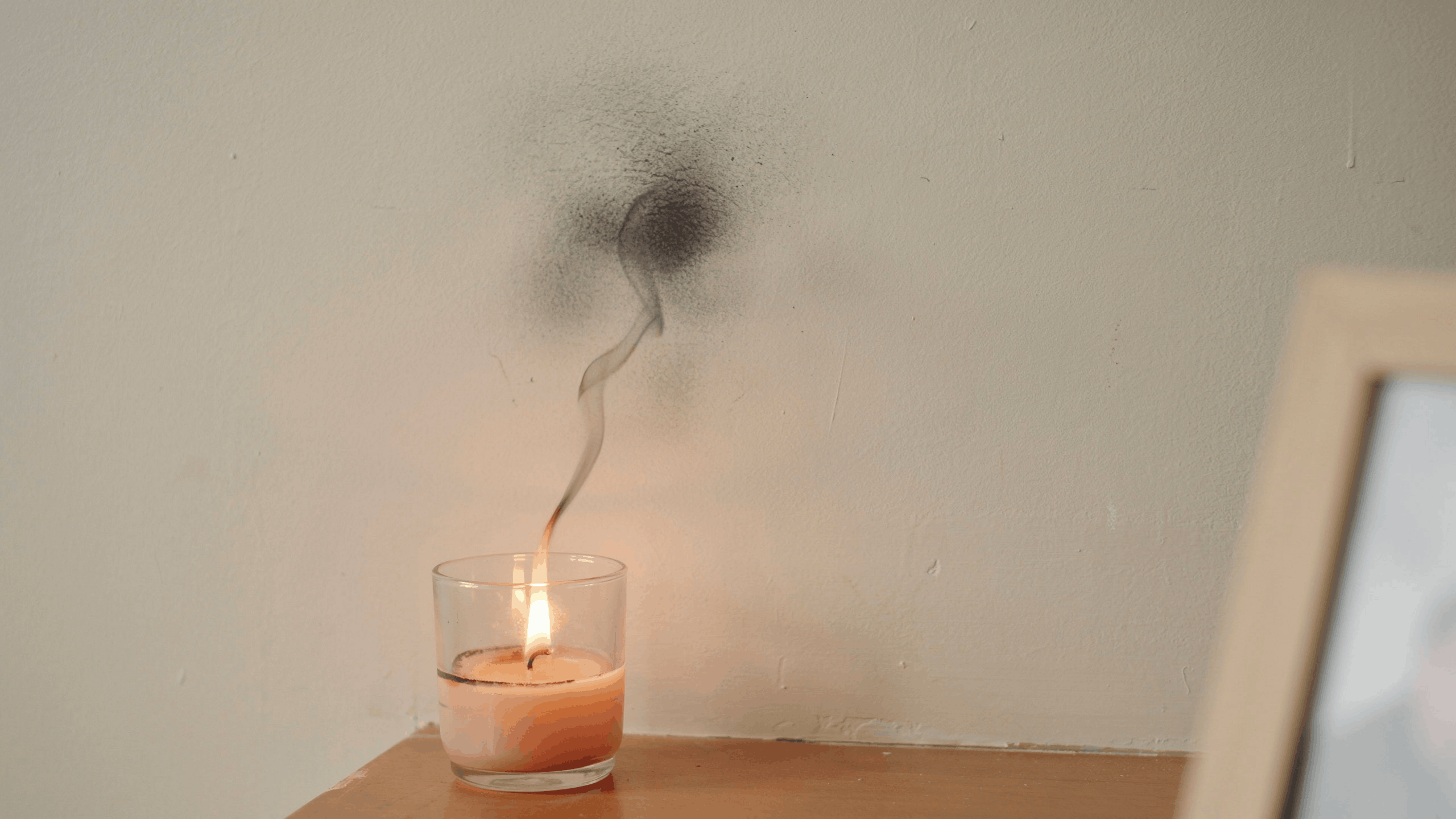
You noticed it slowly. A gray shadow on the ceiling above the coffee table. A black ring baked onto the rim of your favorite jar candle. A faint smudge on the wall behind the sconce where you burn one every evening.
Most people blame the candle. Cheap wax, bad batch, too much scent. They toss it and buy a “cleaner” brand. They’re fixing the wrong thing.
The wax is almost never the real problem
Those black marks aren’t proof you bought a bad candle. They’re proof something’s going wrong in the air right above the flame every time you burn it. And it has almost nothing to do with what the candle’s made of, and everything to do with how you’re burning it.
The part most people don’t know: candle soot is real soot. It’s the same fine black powder that comes off a car’s exhaust pipe or an old furnace, just in tiny amounts. According to the National Candle Association, a candle burning the way it’s supposed to turns its wax almost fully into invisible gas and water vapor. When it doesn’t, tiny bits of black soot float off into the room instead.
That soot is what you’re seeing on your walls. It rides the warm air rising off the candle up to the ceiling, then drifts outward until it hits something cooler, a wall, a lampshade, a picture frame, and sticks. Flat paint holds onto it especially well because the surface has a slight texture that grabs the particles.
Now the part people really don’t know. A 2021 study in Indoor Air looked at what happens when a candle flame’s flickering, forming a black lump at the wick tip, or fighting a draft. Researchers called it “stressed burning,” and it pumped out a lot more soot, harmful smoke chemicals, and fine dust than a clean flame. A 2025 study in Scientific Reports backed it up: an unsteady flame throws far more junk into the air than a steady one.
That “fine dust” has a name: PM2.5. Those are bits small enough to slip past your nose and get deep into your lungs, the same kind the EPA warns about during wildfire smoke. The EPA also says indoor air is often two to five times dirtier than the air outside, and Americans spend about 90% of their time indoors. A candle burning the wrong way for four hours in a closed room isn’t a small thing.
Why burning it longer makes everything worse
Think of a candle as a tiny fuel pump. The flame melts the wax, the wick soaks it up like a straw, and at the tip that liquid wax turns into a gas the flame can burn. When fuel and air are balanced, you get a small, quiet, teardrop-shaped flame. No soot.
That balance breaks the longer you burn the candle.
As the wax burns down, the wick gets longer. A too-long wick soaks up more wax than the flame can burn. The extra fuel turns into a black lump at the tip, the one candle makers call a “mushroom.” Once that mushroom forms, the flame gets taller, hotter, and shakier. Every flicker sends a puff of soot into the air.
The pool of melted wax is the second problem. Past three or four hours, that pool overheats. Overheated wax makes the flame flare higher and pull up even more fuel. Companies that clean fire and smoke damage for a living say the dirty streaks that look like years of grime on a wall can build up in a single evening of a big three-wick candle burning wrong
So the marks on your walls are really the story of a flame that got too big, too hot, and too well-fed for too long. Pricey candles do it too. Even soy and beeswax, which do burn a little cleaner than paraffin, will still soot up your walls if you burn them wrong.
The fix is smaller than you’d guess
It comes down to a handful of small habits, none of them costing a thing.
Trim the wick to ¼ inch (about 6 mm) before every burn. Not once a week. Every time you light the candle, before you strike the match. A short wick keeps the flame small and steady, and starves it of the extra fuel that makes it mushroom. The National Candle Association says this one habit alone can make your candle last up to 25% longer, on top of keeping your walls clean. A cheap wick trimmer works best, but small scissors or nail clippers do fine.
Cap every burn at 3 to 4 hours, then let it cool at least 2 hours before you light it again. The National Candle Association is clear about this: after four hours, the wax pool overheats, the wick lumps up, and soot really starts flying. The two-hour rest lets everything settle back down.
Keep the candle away from moving air. Not near an open window, an AC vent, or a ceiling fan. Drafts make the flame flicker, and every flicker is another puff of soot. If the flame won’t sit still, move the candle somewhere calmer.
Snuff the flame out. Don’t blow it. Blowing sends a burst of smoke and unburned wax into the room. A snuffer, a wick dipper, or the back of a spoon pressed over the flame for a second kills it cleanly, with barely any smoke.
Keep the candle at least 12 inches (about 30 cm) from the nearest wall. The closer it is, the less room the warm sooty air has to travel before it slams into a cool surface and drops its load right there.
If your candle has three wicks, all these rules matter three times as much.
What you get back
Do this for a month and things change. The black ring stops forming on your jars. The flame sits low and quiet instead of jumping around. The gray shadow above your candle spot stops growing. And the candle you paid $30 for lasts as long as the label said.
Sources: (1) National Candle Association: Your Foolproof Guide to Burning a Candle Correctly; (2) Andersen et al., Indoor Air (2021): Emissions of soot, PAHs, ultrafine particles, NOx, and other health relevant compounds from stressed burning of candles in indoor air; (3) Scientific Reports (2025): Impact of scented candle use on indoor air quality and airborne microbiome; (4) U.S. Environmental Protection Agency: Indoor Air Quality; (5) Lawrence Berkeley National Laboratory: Compilation of Published PM2.5 Emission Rates.
The post The candle mistake that’s leaving black marks on your walls: the fix is surprisingly easy appeared first on Trendir.